


Ingredient Research
Argireline® (Acetyl Hexapeptide-8)
A synthetic hexapeptide shown in clinical studies to visibly soften the look of expression lines around the eyes and forehead.
48.9%
Rated clearly smoother in 4 weeks
22 of 45 people using 10% Argireline were graded clearly smoother around the eyes by clinicians after 4 weeks, against 0 of 15 on placebo, in a double-blind trial (Wang et al., 2013).
−7.4%
Forehead roughness at day 20
With 10% Argireline, against +4.3% with placebo (p = 0.022), measured by skin-surface imaging in a 24-woman trial (Raikou et al., 2017).
4 weeks
Time to the trial's result
The double-blind trial graded improvement after 4 weeks of twice-daily use; the forehead result was significant at day 20. No adverse effects were reported in either trial (Wang et al., 2013; Raikou et al., 2017).
What Is Argireline?
Argireline® is the trade name of acetyl hexapeptide-8 (also listed as acetyl hexapeptide-3), a synthetic peptide developed by Lipotec, now part of Lubrizol. It softens the look of expression lines around the eyes and forehead. In a double-blind, placebo-controlled trial, nearly 1 in 2 people using 10% Argireline were graded clearly smoother around the eyes after 4 weeks. On placebo, no one was.
Its results have been measured with silicone skin replicas and skin-surface imaging, not only judged by eye.
Written by the Skingenetix Research Team, which compiles the claims registers behind these pages.
By Skingenetix. Medically reviewed by Dr Esther Bodde, Cosmetic & Medical Physician. Every figure checked against the published paper or its PubMed record. Last reviewed 23 September 2026.
At a glance
- What it is: Argireline®, the trade name of acetyl hexapeptide-8, a synthetic peptide modelled on part of a protein involved in facial expression, used to soften the look of expression lines.
- Best evidence: 22 of 45 people using 10% Argireline were graded clearly smoother around the eyes after 4 weeks, against 0 of 15 on placebo, with roughness down on silicone skin replicas, in a double-blind trial (Wang et al., 2013).
- Independent evidence: a 24-woman placebo-controlled trial found forehead roughness down at day 20 (Raikou et al., 2017). The only independent imaging test found no difference between a serum with Argireline and the same serum without it in 19 women (Henseler, 2023).
- Not shown: that it reaches the muscle. A regulator's lab study found none of it in the dermis; any effect is at the skin surface. It is not a needle-free alternative to injections.
- Safety: no adverse effects reported in the controlled trials. Patch-test first.
- How to use: twice a day around the eyes and forehead, for 4 weeks, with SPF in the morning.
To use it in a routine, see our guide to fine lines and wrinkles.

What Does Argireline Do for Expression Lines?
Expression lines form where facial muscles repeatedly contract, such as crow’s feet and forehead lines. Argireline is modelled on part of the SNAP-25 protein, and in laboratory studies it interferes with the SNARE complex that nerve endings use to release the signal for a muscle to contract (Blanes-Mira et al., 2002).
Here is what the evidence shows, strongest first. Each line opens the study behind it.
Both placebo-controlled trials above used 10% Argireline, the level in our serum.
Read our appraisal of the 60-person placebo-controlled trial and our appraisal of the forehead-lines trial. Another controlled trial also used 10%:
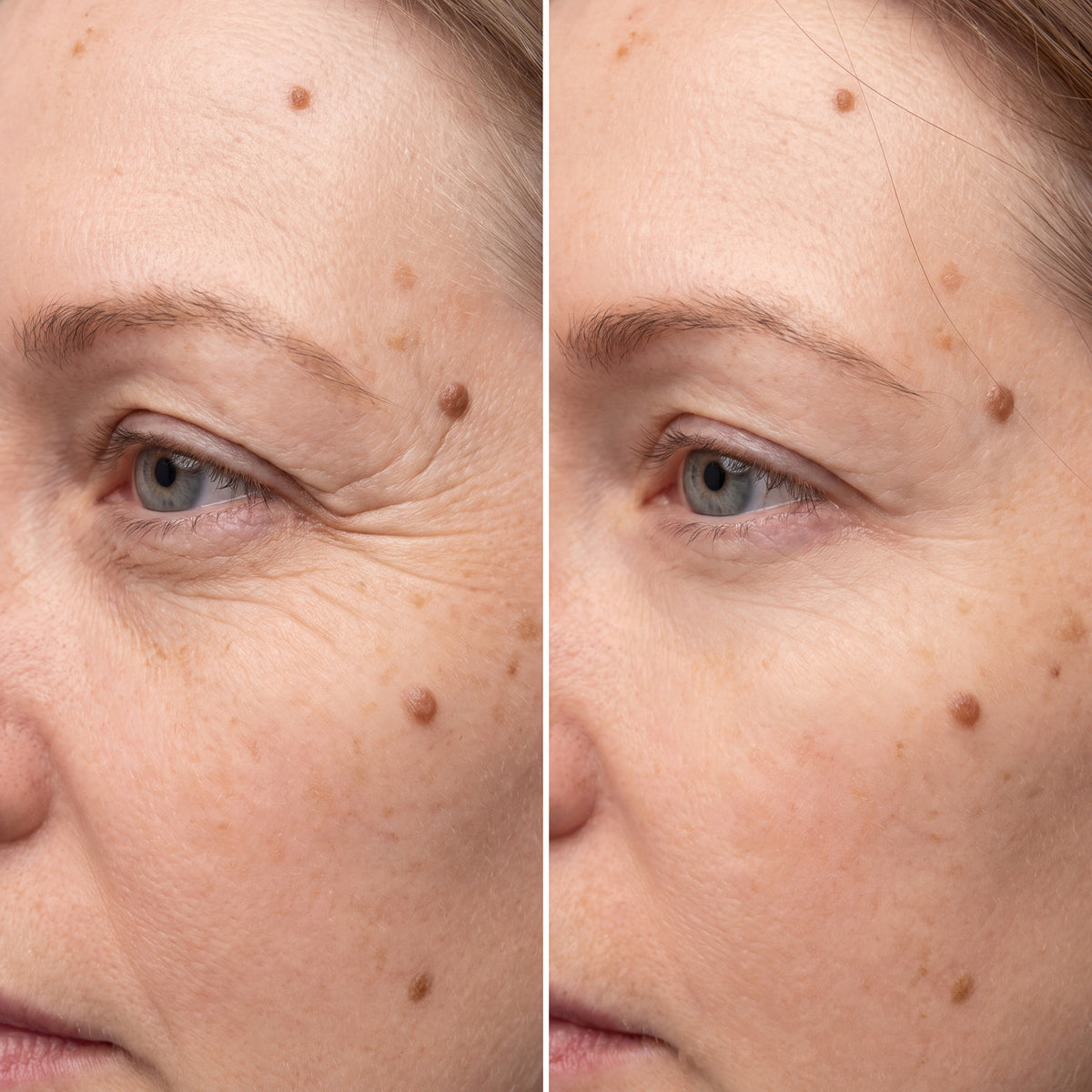
Before
After 4 weeks
22 of 45 graded clearly improved vs 0 of 15 on placebo
22 of 45 Graded Clearly Improved — None on Placebo
A randomized, placebo-controlled trial examined the anti-wrinkle effects of topical Acetyl Hexapeptide-8 applied twice daily to the periorbital region (crow's feet area).
Study design: RCT, placebo-controlled, 60 subjects (3:1 ratio), 4 weeks, twice daily application
Key results:
- 22 of 45 people (48.9%) were graded clearly improved by clinicians, against 0 of 15 on placebo. This is the share of people who improved, not a 48.9% reduction in wrinkles.
- All objective roughness parameters decreased significantly (p < 0.01)
Wang Y et al. (2013). American Journal of Clinical Dermatology. View on PubMed

Before
After 20 days
Forehead roughness −7.4% vs +4.3% on placebo (day 20)
Forehead Roughness −7.4% by Day 20
A second placebo-controlled trial measured the forehead with skin-surface imaging. With 10% Argireline, forehead roughness fell 7.4% by day 20, while on placebo it rose 4.3%.
Study design: randomised, placebo-controlled. 24 women aged 30 to 60 applied a cream with 10% Argireline, or a placebo cream, twice a day.
Results with 10% Argireline:
- Forehead roughness −7.4% at day 20, against +4.3% on placebo (P = .022)
- Skin held on to moisture better than on placebo at days 20 and 40
Raikou V et al. (2017). J Cosmet Dermatol, 16(2):271–278. View on PubMed
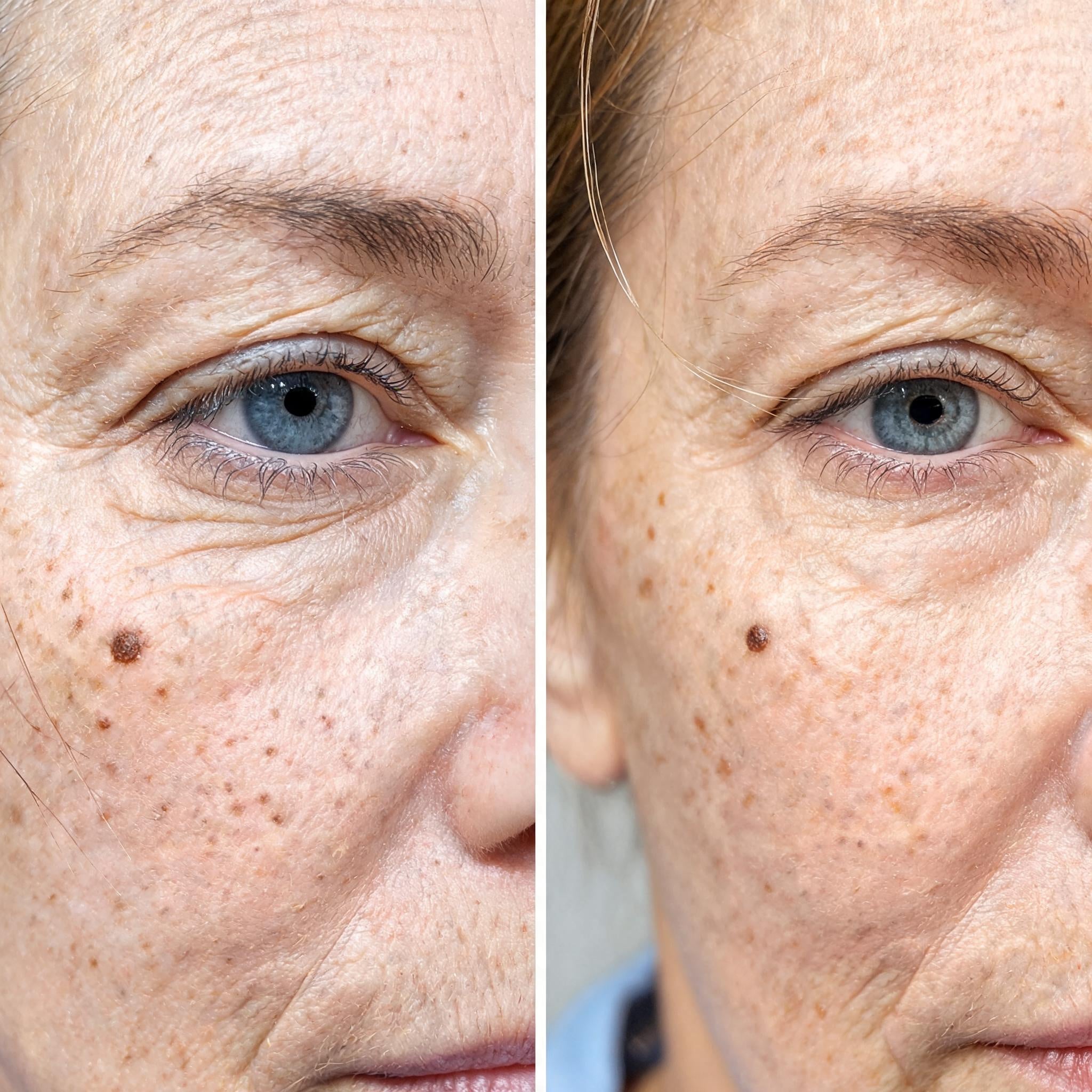
Before
After 30 days
Up to ~30% softer-looking wrinkle depth
Up to ~30% Softer-Looking Wrinkle Depth in 30 Days
An early study by the peptide's developers combined laboratory (in-vitro) mechanism data with a small in-use test of an Acetyl Hexapeptide-8 emulsion.
Study design: Combined in-vitro + in-use proof-of-concept, healthy female volunteers, 30 days.
Key results:
- Up to ~30% reduction in measured wrinkle depth after 30 days (early proof-of-concept by the developers)
- Supported the appearance of smoother skin around the eyes over 30 days
Blanes-Mira C et al. (2002). International Journal of Cosmetic Science. View on PubMed
No Side Effects Reported in the Controlled Trials
Across the controlled topical studies, no participant reported an adverse effect.
What was reported:
- 45 people using 10% Argireline around the eyes twice daily for 4 weeks: no adverse effects, and nobody stopped the study (Wang et al., 2013)
- No warmth, stinging, redness, peeling, itching or eye irritation in the peptide arms of a 60-day trial (Raikou et al., 2017)
- No significant adverse events or skin irritation in an independent split-face study (Henseler, 2023)
These studies tested the ingredient itself, not our finished serum. Patch-test any new product on a small area for 24 to 48 hours first.
Argireline® vs Placebo: What the Trials Measured
Two placebo-controlled trials of creams with 10% Argireline®: one around the eyes, one on the forehead.
Crow's feet clearly improved after 4 weeks
Share of people a clinician graded 3 or 4 on a 0–4 improvement scale. Double-blind trial, 60 adults, cream twice a day.
10% Argireline® (45 people)
Placebo (15 people)
| Group | Share clearly improved |
|---|---|
| 10% Argireline® (45 people) | 22 of 45 (48.9%) |
| Placebo (15 people) | 0 of 15 |
Nearly half of the Argireline® group (22 of 45) was graded clearly improved after 4 weeks, and no one on placebo (Wang et al., 2013). 48.9% is the share of people improved, not the size of the change in each wrinkle.
Silicone replicas of the skin confirmed smoother skin in the Argireline® group (p<0.01) and no significant change on placebo.
Forehead roughness
Change in skin roughness (cR2, Visioscan). Placebo-controlled trial, 24 women, cream with 10% Argireline® twice a day.
10% Argireline®Placebo
Day 20 (significant)
| Day | 10% Argireline® | Placebo |
|---|---|---|
| Day 20 (significant) | −7.4% | +4.3% |
Left of zero is smoother. At day 20, roughness fell 7.4% with Argireline® and rose 4.3% on placebo, a significant difference, p = 0.022 (Raikou et al., 2017).

What 10% Argireline® Means
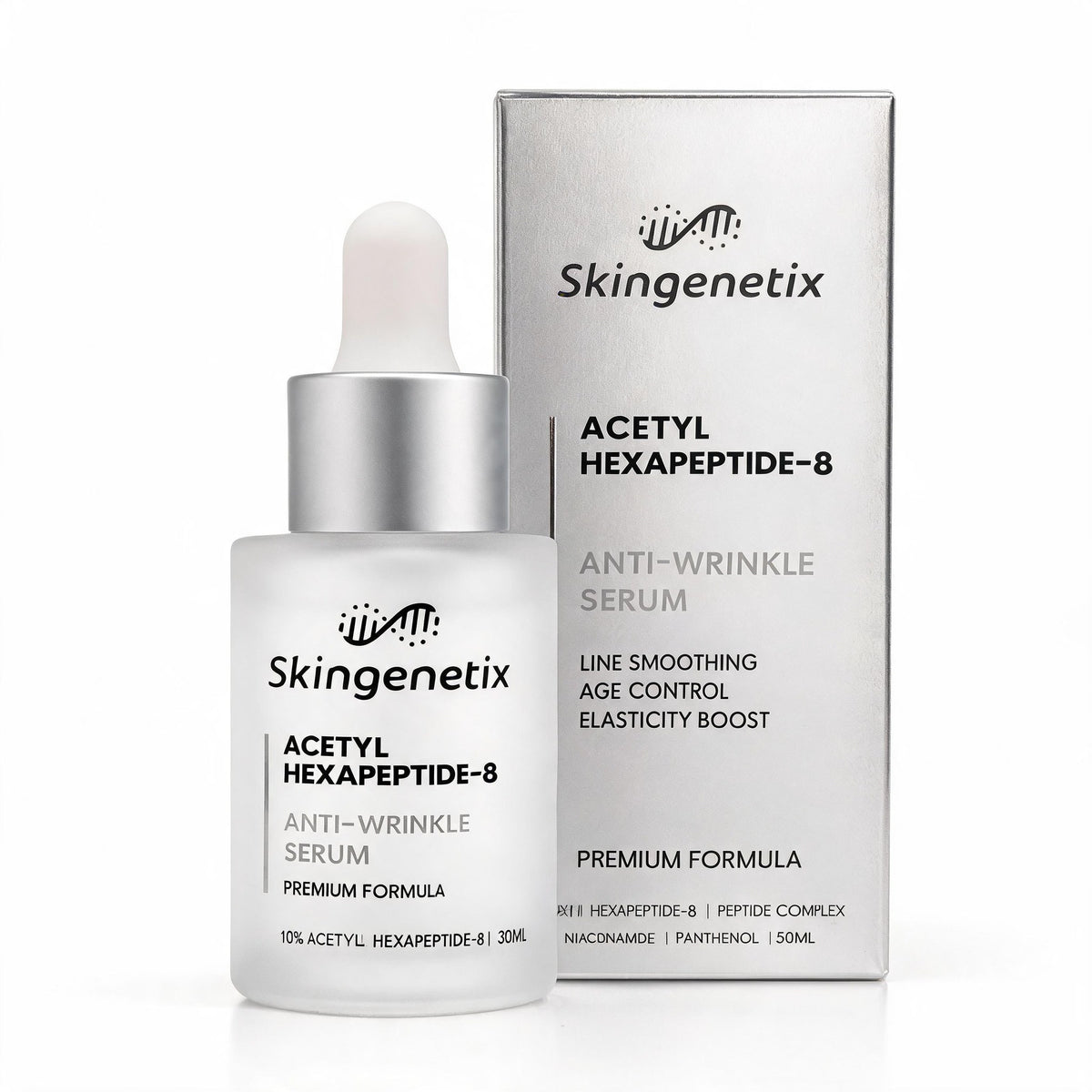
The Skingenetix Acetyl Hexapeptide-8 Serum contains 10% Argireline®, and we state the percentage on the bottle so you can compare like with like.

How to Use Argireline
- 1Start cleanOn freshly cleansed skin, before anything else goes on.
- 2Apply where the lines formThree to four drops, twice a day, across the forehead, between the brows and around the eyes.
- 3Seal it inFollow with a moisturiser — and with SPF every morning.
It layers well with other peptides such as Matrixyl 3000, which supports the look of firmer skin rather than relaxing expression lines.
Argireline Evidence & Sources
Every study this page relies on, with its published title, our reading of it and a link to the source. Graded A controlled human trial measured by instrument · B smaller, uncontrolled or manufacturer data · C tests on skin samples · Review a summary of other work.
| Study | Grade | What it found |
|---|---|---|
The anti-wrinkle efficacy of a synthetic hexapeptide in Chinese subjects: a randomized, placebo-controlled study Wang et al., 2013 · Am J Clin Dermatol · 14(2):147–53 View on PubMed → | A | 60 adults (45 active, 15 placebo), 10% Argireline twice daily around the eyes for 4 weeks, double-blind and placebo-controlled. 22 of 45 (48.9%) were graded clearly improved against 0 of 15 on placebo — a count of people, not a wrinkle measurement. Silicone replicas showed roughness down (p < 0.01). Product supplied by the Argireline marketer in China. |
The efficacy study of the combination of tripeptide-10-citrulline and acetyl hexapeptide-3 Raikou et al., 2017 · J Cosmet Dermatol · 16(2):271–8 View on PubMed → | A | 24 women, about 6 per arm, 10% Argireline twice daily for 60 days. Forehead roughness −7.4% at day 20 against +4.3% on placebo (P = .022). Skin held moisture better at days 20 and 40. Actives supplied by the maker's distributor. |
Acetyl hexapeptide-3 in a cosmetic formulation acts on skin mechanical properties Tadini, Mercurio & Campos, 2015 · Braz J Pharm Sci · 51(4) View study → | A | 40 women, 10% Argireline for 2 and 4 weeks against the vehicle. Skin became more uniform in how it resists stretching (p < 0.05), a feature of younger skin. |
A synthetic hexapeptide with antiwrinkle activity Blanes-Mira et al., 2002 · Int J Cosmet Sci · 24:303–10 View on PubMed → | B | The developers' own study. An emulsion with 10% Argireline reduced measured wrinkle depth up to 30% in 30 days. Figures as reported in the study's abstract. |
Manufacturer in-vivo study, reported in trade press (not peer-reviewed) Lipotec, 2013 · Personal Care Magazine no PubMed record | B | 24 women, split-face, a cream with 2% Argireline solution twice daily for 7 days. Wrinkle volume −20.6% and length −15.9%. The ingredient maker's own unpublished study, at a fifth of our concentration, and it is not stated whether the figure is against baseline or against the placebo side. |
In vitro skin penetration of acetyl hexapeptide-8 from a cosmetic formulation Kraeling et al., 2015 · Cutan Ocul Toxicol · 34(1):46–52 View on PubMed → | C | A US regulator's laboratory study on human and guinea-pig skin. Most of the dose washed off; 0.22% stayed in the outermost layer and 0.01% reached the epidermis, with none detected in the dermis. This is the basis for saying the peptide does not reach the muscle, and that any effect is at the skin surface. |
Topical delivery of acetyl hexapeptide-8 from different emulsions: influence of emulsion composition and internal structure Hoppel et al., 2015 · Eur J Pharm Sci · 68:27–35 View on PubMed → | C | Franz cells on pig-ear skin. Water-rich emulsions delivered clearly more peptide than oil-rich ones. |
Acetyl Hexapeptide-8 in Cosmeceuticals - A Review of Skin Permeability and Efficacy Zdrada-Nowak et al., 2025 · Int J Mol Sci View on PubMed → | Review | Concludes that low penetration limits how much peptide is available and that reaching the neuromuscular junction “remains uncertain”, so any effect is likely to be in the upper skin. Misquotes Wang 2013 as a “49% reduction in wrinkle depth”; we cite Wang directly instead. |
Published titles are quoted exactly as they appear in the journal.
Frequently Asked Questions
Everything you need to know about Acetyl Hexapeptide-8.
What is Acetyl Hexapeptide-8?
Acetyl Hexapeptide-8 is a synthetic peptide developed by Lipotec (now Lubrizol). Applied topically, it is valued in skincare for helping to visibly relax the look of expression lines around the eyes and forehead for a smoother appearance.
How effective is Acetyl Hexapeptide-8 for wrinkles?
In a randomized, placebo-controlled trial, 22 of 45 people (48.9%) were graded clearly improved by clinicians after 4 weeks, against 0 of 15 on placebo (Wang 2013). That is the share of people who improved, not a 48.9% reduction in wrinkles. Argireline is used for the look of dynamic expression lines: crow's feet, forehead lines and frown lines.
Does Argireline work?
In two placebo-controlled trials, yes, for the look of expression lines. In a 4-week trial of 60 adults, clinicians graded 22 of the 45 people using the 10% peptide as clearly smoother around the eyes, and no one on placebo; silicone replicas of the skin confirmed lower roughness. In a second trial, forehead roughness fell 7.4% by day 20 against a 4.3% rise with placebo (p = 0.022). The effect is on how the lines look where the product is applied, after weeks of use; it is not permanent and it does not change how the skin works.
Is Argireline better than retinol?
No trial has compared them, so no one can say. They do different jobs: retinol is a vitamin A derivative used for the look of lines and texture; Argireline® is a peptide tested for the look of expression lines such as crow's feet and forehead lines. Many people use both, the peptide morning and evening on expression lines and retinol at night. Introduce one new product at a time.
What should I avoid using with Argireline, and who should be careful?
No combination was tested in the trials, so there is no evidence either way on mixing. It is not an acid, so it layers with peptides, hyaluronic acid and vitamin C; if you use strong acids or high-strength retinol, apply them at a different time of day. For use on the skin only: never inject it and never use it with needling devices. It has not been tested in pregnancy or while breastfeeding, so ask your doctor or pharmacist first. Patch-test any new product, keep it out of the eyes, and stop if stinging or redness does not settle. No side effects were reported in the controlled trials; our own serum has no tolerance study of its own.
How does Acetyl Hexapeptide-8 work on expression lines?
Argireline® is a peptide modelled on part of SNAP-25, a protein involved in facial expression, and it is designed to soften the look of expression lines such as crow's feet and forehead lines. Laboratory studies describe how it may act on skin cells; in people, the controlled trials measured smoother-looking skin around the eyes after 4 weeks and smoother forehead texture from day 20, with twice-daily use.
What concentration does Skingenetix use?
The Skingenetix Acetyl Hexapeptide-8 Serum contains 10% Argireline® peptide solution, the level used in the clinical trials.
How long before I see results?
In clinical studies of the ingredient, forehead skin was measurably smoother at day 20, and after 4 weeks clinicians graded nearly half of users' crow's feet as clearly smoother, against none on placebo. Apply twice a day to clean skin and give it at least 4 weeks.
Shop Acetyl Hexapeptide-8 Products
Explore More Research
Using it alongside Matrixyl 3000? Read Argireline and Matrixyl 3000 together: what the trials show.

Copper Peptide (GHK-Cu)
Supports the skin's collagen and renewal pathways
Matrixyl 3000
A clinically studied peptide for smoother-looking skin

PDRN
For firmer, revitalised-looking skin

Glutathione
A clinically studied antioxidant for brighter-looking skin
Try Acetyl Hexapeptide-8
Experience the research in our Acetyl Hexapeptide-8 Expression Line Reducing Serum.