
What Is Microneedling? What It Does, What It Can’t, and What the Research Shows
What is microneedling? It is a skin treatment that uses very fine needles to make tiny, short-lived channels in the skin, which sets off the skin’s repair process and triggers new collagen. It is studied for fine lines, texture, pores, pigmentation and acne scars, and it is done with a stamp, roller, pen or radiofrequency device.
By the Skingenetix Research Team, medically reviewed by Dr Esther Bodde, 17 November 2026
83%
were satisfied with the treatment
A 2025 systematic review of 21 studies and 723 people (Foppiani 2025).
about 40%
lowered facial wrinkle scores
In a controlled trial with a 0.5 mm roller, applied by clinicians (Liang 2022).
3.4 points
scar scores lower than baseline at six months
On the needled side and no significant change on the other (Alam 2014).
In short:
- Does it work? In controlled clinic trials, measured scores for wrinkles, texture, pores and the look of acne scars improved, by modest and varied amounts. No controlled trial of an at-home facial stamp has been published yet.
- What does it add to skincare? In laboratory studies, microneedling let more of a water-soluble ingredient cross the skin.
- How often? Our stamp sets are used every two weeks, after any redness has gone: the 0.5 mm clinic trial spaced its sessions two weeks apart, and at 0.5 mm the skin barrier took 48 to 72 hours to recover.
- Who should avoid it? People with an active infection, a clotting disorder or a metal allergy, and anyone on blood thinners (full list below).
What is microneedling, and what else is it called?
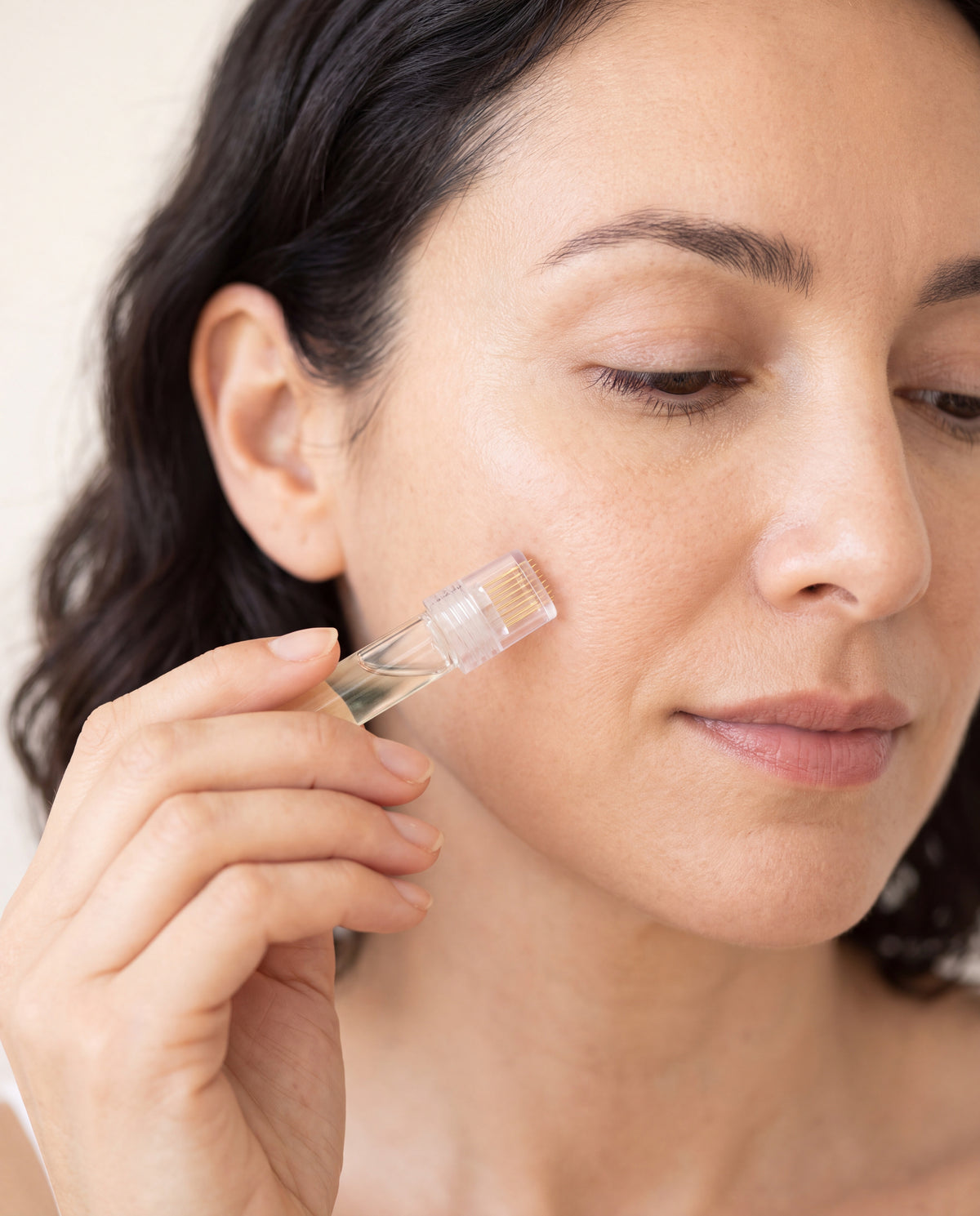
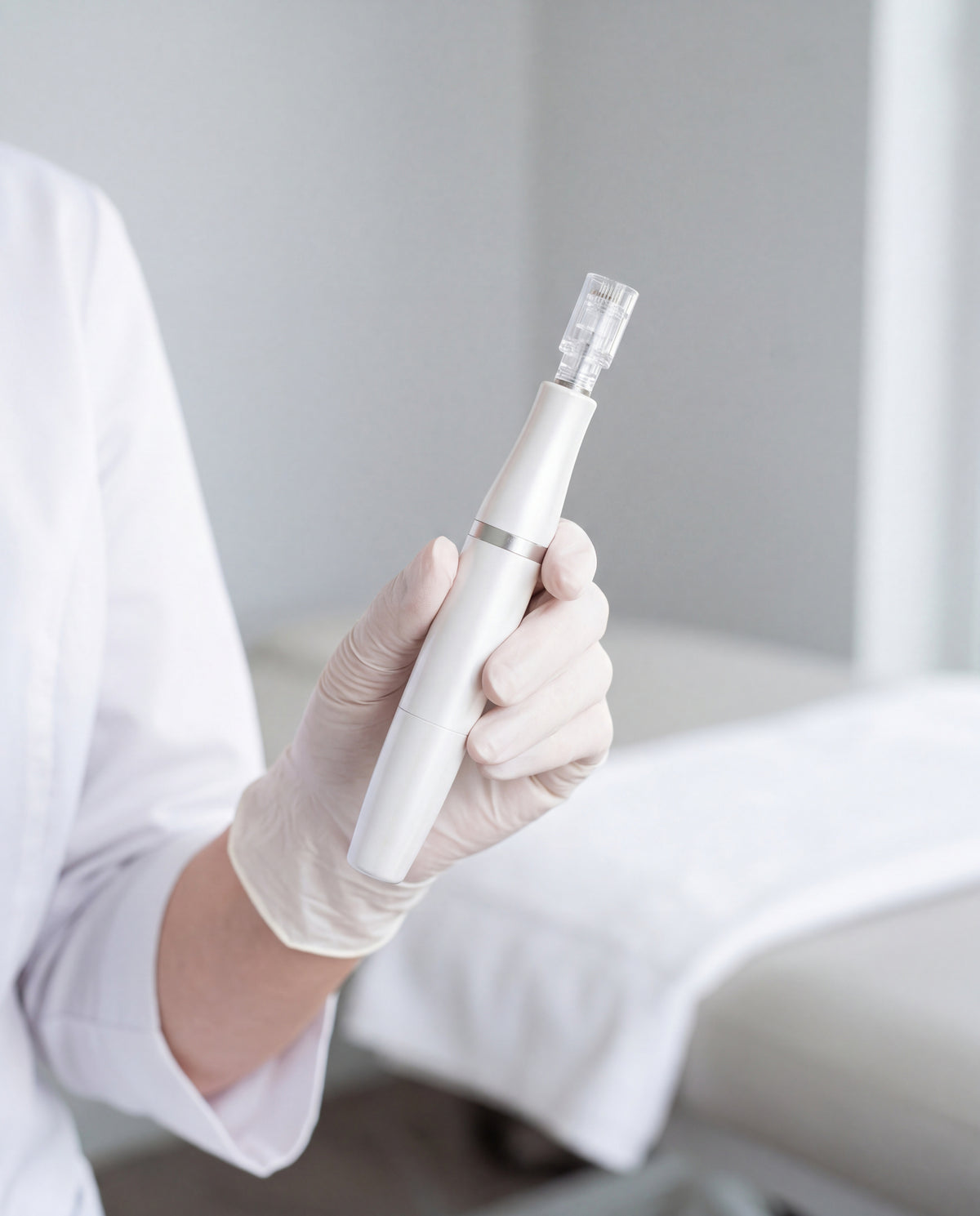
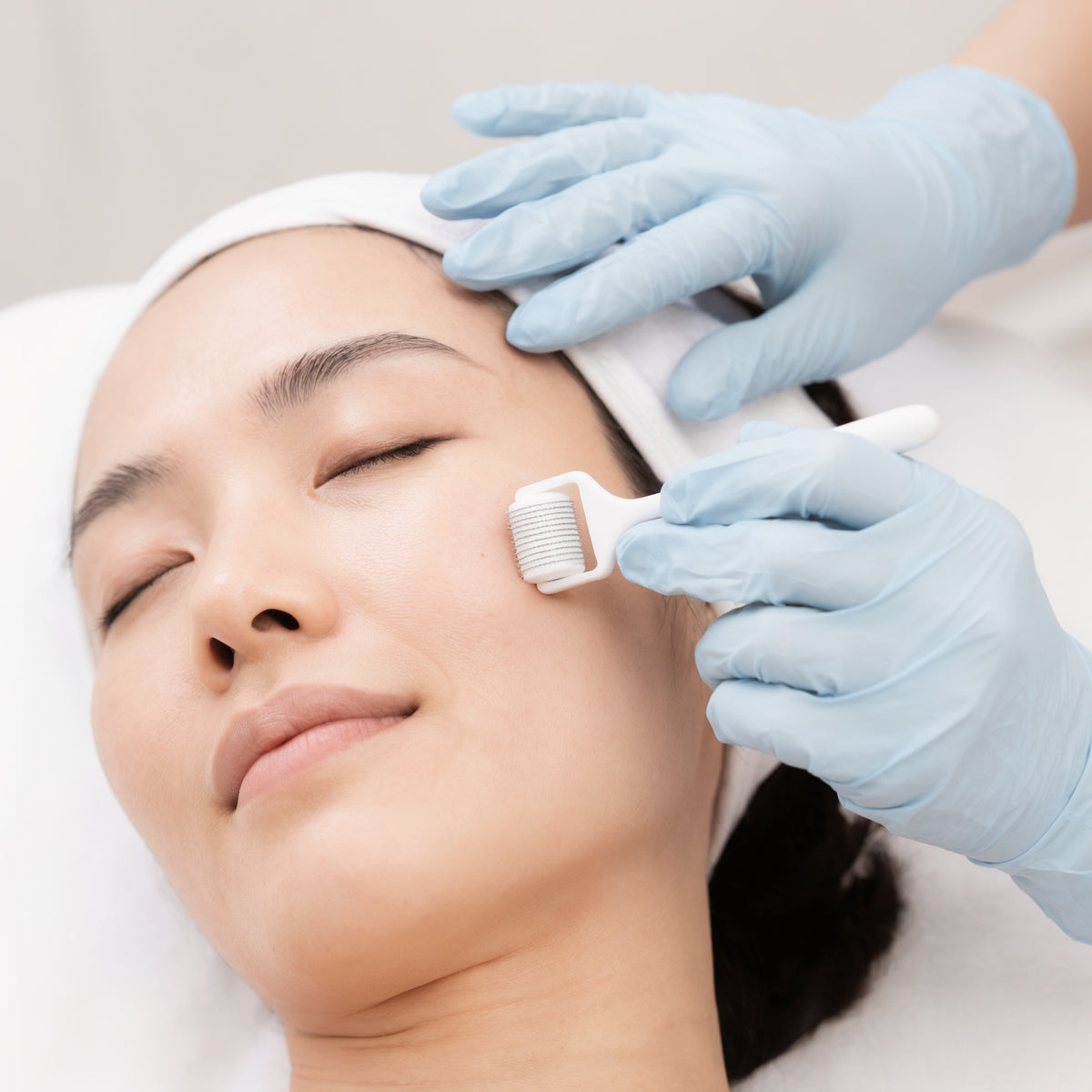
Microneedling is a procedure in which a device of fine needles is pressed or rolled over the skin to make many tiny punctures. Needle length sets the depth: the FDA notes that the shortest needles touch only the top layer of skin, while longer ones reach the deeper layers where living cells are.
It is also called percutaneous collagen induction therapy, collagen induction therapy or skin needling, and is searched as micro needling or micro-needling. All describe the same technique.
How does microneedling work?
Channels that trigger repair and new collagen
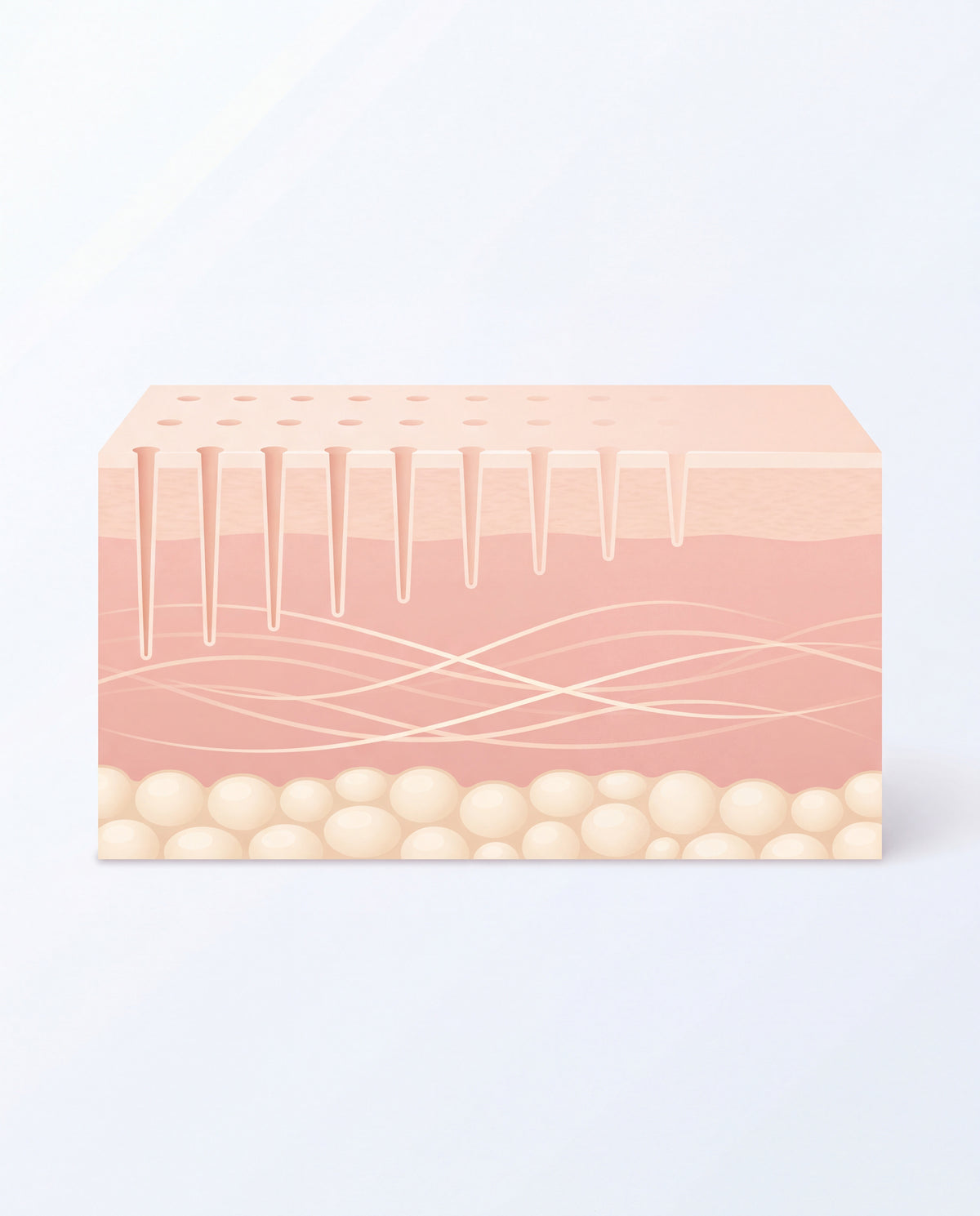
Microneedling works by making channels that trigger the skin’s repair mechanism, which includes new collagen. In an uncontrolled study of 10 patients given six sessions, biopsies taken one and three months after treatment began showed significantly more collagen types I, III and VII, and more new collagen, than before (El-Domyati 2015).
Short-lived channels and skin barrier recovery
The channels are short-lived. In studies of the face, the skin barrier recovered within about 1 to 3 days after 0.25 to 0.5 mm needles. At 0.5 mm it took 48 to 72 hours after ordinary microneedles (Tao 2017: 16 volunteers, randomised split-face, followed for 72 hours). In 10 adults aged 21 to 55, water loss at 0.5 mm stayed slightly above baseline for 48 hours and was higher still at 1.5 mm (Sasaki 2019: a small water-loss study).

In laboratory studies, more of an ingredient crosses the skin
Microneedling can also change what a serum does. A 2026 meta-analysis of 29 laboratory studies on skin samples, not people, found that microneedling increased the amount of an ingredient crossing the skin, more so for water-soluble ingredients and for needles of 0.5 mm or longer (Kam 2026). In a laboratory test on human skin samples, a polymer microneedle array let 134 nanomoles of copper peptide through in 9 hours, while almost none crossed untreated skin (Li 2015: it measures amount, not depth); our copper peptide research page covers it.
PDRN: clinic trials alongside radiofrequency microneedling
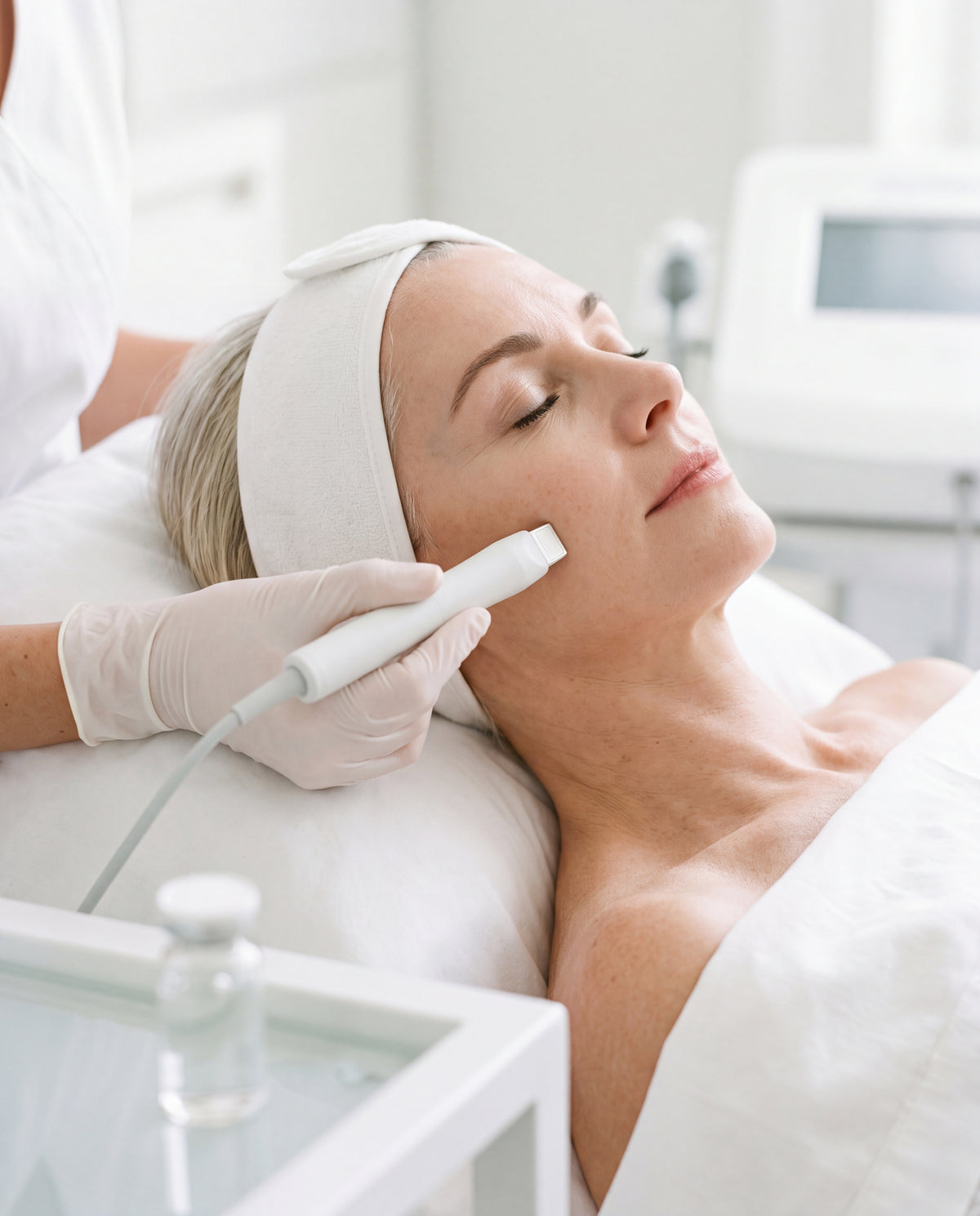
PDRN, the ingredient in one of our two stamp sets, has clinic trials alongside radiofrequency microneedling, on eye-area wrinkles (Yogya 2022) and on melasma (Gulfan 2022). Our PDRN research page sets out the evidence, and our salmon sperm skincare article separates PDRN skincare from the salmon sperm facial.
Does microneedling work? What the trials found, by skin concern
In controlled trials, microneedling improved measured scores for wrinkles, texture, pores and the look of acne scars, by varied amounts.
A 0.5 mm roller, five sessions: facial wrinkle scores down about 40%
In a controlled trial with a 0.5 mm roller, applied by clinicians, five sessions of microneedling with plain saline lowered facial wrinkle scores by about 40%; the side that also had a stem-cell serum improved more (Liang 2022: randomised, split-face, 28 adults). 0.5 mm is also the needle length of our stamp sets.
83% were satisfied across 21 studies
A 2025 systematic review of 21 studies and 723 people (72% women, average age 48) found that 83% were satisfied with the treatment (Foppiani 2025: measures satisfaction, not skin scores).
The studies, concern by concern
The table sets out the studies behind each concern, with who paid and their limits.
| Concern | Needle depth in the trial | Sessions | Result, people and design | Clinic or home | Source | Who paid, and limits |
|---|---|---|---|---|---|---|
| Wrinkles around the eyes | 0.25 mm roller | 5, every 2 weeks | Roller with saline: no significant change in eye-area wrinkle roughness. With a stem-cell medium: improved. 25 women with Asian skin; randomised split-face.Trial: 0.25 mm roller; Sessions: 5, every 2 weeks; Clinic; Lee 2014 | Clinic | Lee 2014 | Korean Ministry of Health and Welfare grant. Limit: small trial. |
| Wrinkles around the eyes | 0.8 to 1.5 mm, radiofrequency | 3, every 2 weeks | At 6 months most of 29 women (skin types III to V) rated their eye-area wrinkles 25 to 75% better. Randomised split-face.Trial: 0.8 to 1.5 mm, radiofrequency; Sessions: 3, every 2 weeks; Clinic; Yogya 2022 | Clinic | Yogya 2022 | Siriraj Hospital; Thai companies provided the device and products tested, and a third paid the journal fee; authors have nothing to disclose. Limit: clinic device; results self-rated. |
| Wrinkles on the face | 0.5 mm roller, 192 needles, applied by clinicians | 5, every 2 weeks | Saline side: wrinkle score down about 40%, from 18.2 to 10.7. 28 of 30 adults aged 35 to 60 with facial skin aging; randomised split-face.Trial: 0.5 mm roller, 192 needles, applied by clinicians; Sessions: 5, every 2 weeks; Clinic; Liang 2022 | Clinic | Liang 2022 | Beijing Natural Science Foundation; authors declare no commercial ties. Limit: one follow-up, 2 weeks after the last session. |
| Texture, pores and elasticity | 0.5 mm roller | 5, every 2 weeks | Saline side: physicians rated texture moderately or markedly better in 22 of 28 people; pore score from 24.4 to 18.6; elasticity reading from 0.57 to 0.65.Trial: 0.5 mm roller; Sessions: 5, every 2 weeks; Clinic; Liang 2022 | Clinic | Liang 2022 | Same trial, funder and limit as the row above. |
| Wrinkles and texture | 0.2 mm | Twice a week for 3 months | Wrinkle scores 17.3% and texture 17.6% better. 11 healthy women aged 33 to 61 with mild to moderate wrinkling; uncontrolled, with a growth-factor serum.Trial: 0.2 mm; Sessions: Twice a week for 3 months; Home; Quinlan 2022 | Home | Quinlan 2022 | Queen Mary University of London authors; received no funding, and no author has a financial interest in the products; commercial growth-factor serum. Limit: small, no comparison group. |
| Collagen in the skin | Not stated in the abstract | 6, every 2 weeks | Collagen I, III and VII, new collagen and tropoelastin up; total elastin down. 10 people with skin types III and IV and wrinkles; uncontrolled.Trial: Not stated in the abstract; Sessions: 6, every 2 weeks; Clinic; El-Domyati 2015 | Clinic | El-Domyati 2015 | Al-Minya University, Egypt; funding not stated in the abstract. Limit: small, no comparison group. |
| Neck wrinkles | Pen, up to 2.5 mm | 4, monthly | Blinded raters scored wrinkles significantly better at 90 days. 35 healthy adults, 32 finished.Trial: Pen, up to 2.5 mm; Sessions: 4, monthly; Clinic; Alqam 2022 | Clinic | Alqam 2022 | Paid for by the device maker, whose employees are among the authors. Limit: no comparison group. |
| Acne scars (the look of) | Micro-roller; length not stated in the abstract | 3, every 2 weeks | Scar score 3.4 points below baseline at 6 months on the needled side; no significant change on the other. 20 healthy adults aged 20 to 65 with acne scars, 15 finished; randomised, rater-blinded split-face.Trial: Micro-roller; length not stated in the abstract; Sessions: 3, every 2 weeks; Clinic; Alam 2014 | Clinic | Alam 2014 | Registered sponsor Northwestern University; funding not stated in the abstract. Limit: small pilot trial. |
| Dark patches (melasma) | 0.8 to 1.5 mm, radiofrequency | 3, every 2 weeks | Melasma severity and melanin scores improved on both sides at 6 months; patches returned in 3 of 30 people. 30 women, mean age 43, with melasma; double-blind randomised split-face.Trial: 0.8 to 1.5 mm, radiofrequency; Sessions: 3, every 2 weeks; Clinic; Gulfan 2022 | Clinic | Gulfan 2022 | Siriraj Hospital; Thai companies provided the device and products tested, and the device supplier paid the journal fee; authors have nothing to disclose. Limit: clinic device; 26 of 30 followed to 6 months. |
The rows cannot be ranked or added together, because devices, depths, measures and people differ.
What is microneedling good for? Area by area
- 1Under the eyesTwo clinic trialsDirections say to avoid the eye area
- 3For the neckOne clinic studyDirections for our stamp sets cover the face only
- 2On the lipsNo controlled trialDirections for our stamp sets say to avoid the lips
- For pigmentationMelasma, in clinics
- For pores0.5 mm roller trial
- For fine lines and texture0.5 mm roller trial0.2 mm home study
- Acne scarsSplit-face trial12 randomised trials
Microneedling under the eyes
Two clinic trials measured wrinkles around the eyes: a 0.25 mm roller (Lee 2014) and a radiofrequency device at 0.8 to 1.5 mm (Yogya 2022). The directions for our stamp sets say to avoid the eye area; our crow’s feet article covers what has been tested in creams.
Microneedling for the neck
One clinic study has measured neck wrinkles: four monthly pen sessions at up to 2.5 mm (Alqam 2022). The directions for our stamp sets cover the face only.
Microneedling on the lips
We found no controlled trial of microneedling on the lips themselves. The directions for our stamp sets say to avoid the lips, so lip concerns are for a qualified professional.
Microneedling for pigmentation
The pigmentation trials we found are on melasma, in clinics, and mostly add a lightening drug. A systematic review of seven randomised trials and 368 people (96% women) found melasma scores fell (Brasil dos Santos 2022: most trials at high risk of bias and too different to pool). Darker skin tones carry a higher risk of dark marks after needling (Chu 2021), so speak to a doctor first. Our Brightening and Glow page covers what we have appraised for tone.
Microneedling for pores
In the 0.5 mm roller trial the pore score fell from 24.4 to 18.6 on the saline side, and further where a stem-cell serum was added (Liang 2022).
Microneedling for fine lines and texture
In the 0.5 mm roller trial, physicians rated texture better in 22 of 28 people on the saline side (Liang 2022). In the 0.2 mm home study, texture was 17.6% better and wrinkle scores 17.3% better after three months (Quinlan 2022). Our Fine Lines and Wrinkles page covers what we have appraised.
Acne scars: the short answer
For the look of acne scars, a split-face trial found scar scores 3.4 points lower than baseline at six months on the needled side and no significant change on the other (Alam 2014). A 2022 meta-analysis of 12 randomised trials and 414 people reported that microneedling without radiofrequency improved scars more than the comparison treatments (Shen 2022: compares with other treatments).
Stamp, roller, pen and radiofrequency: how do the types compare?
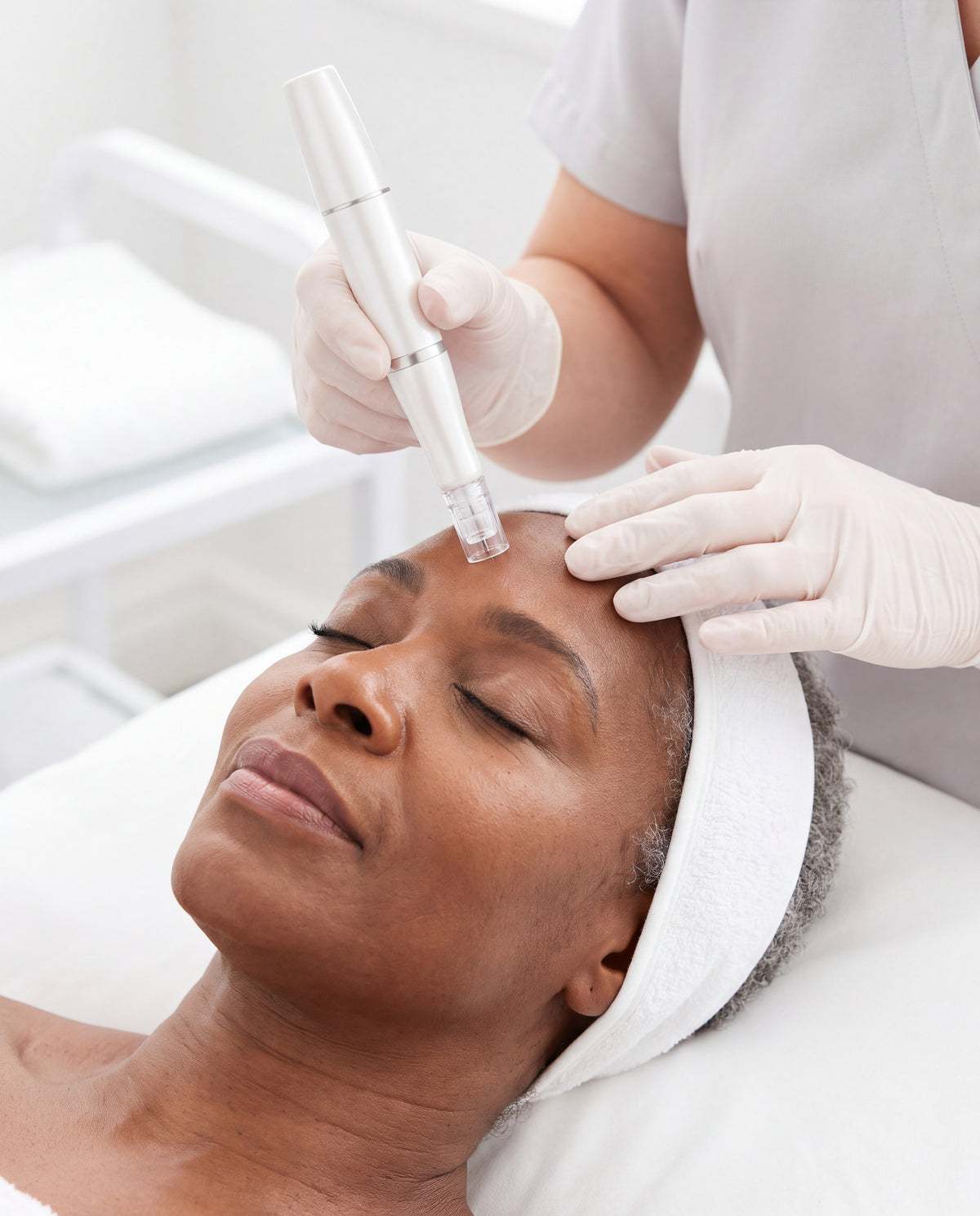
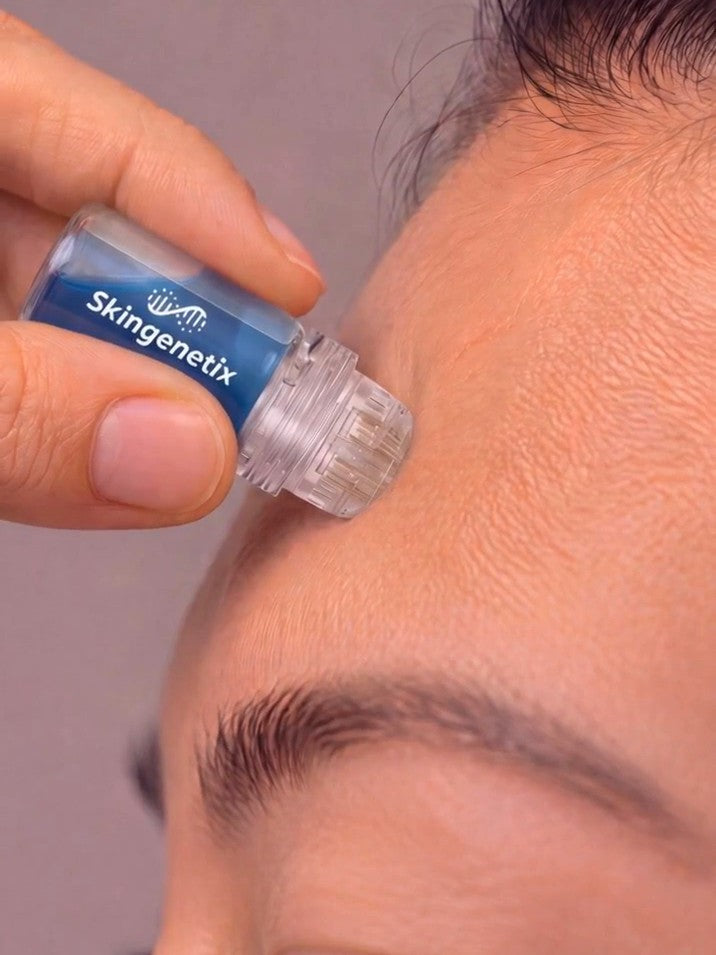
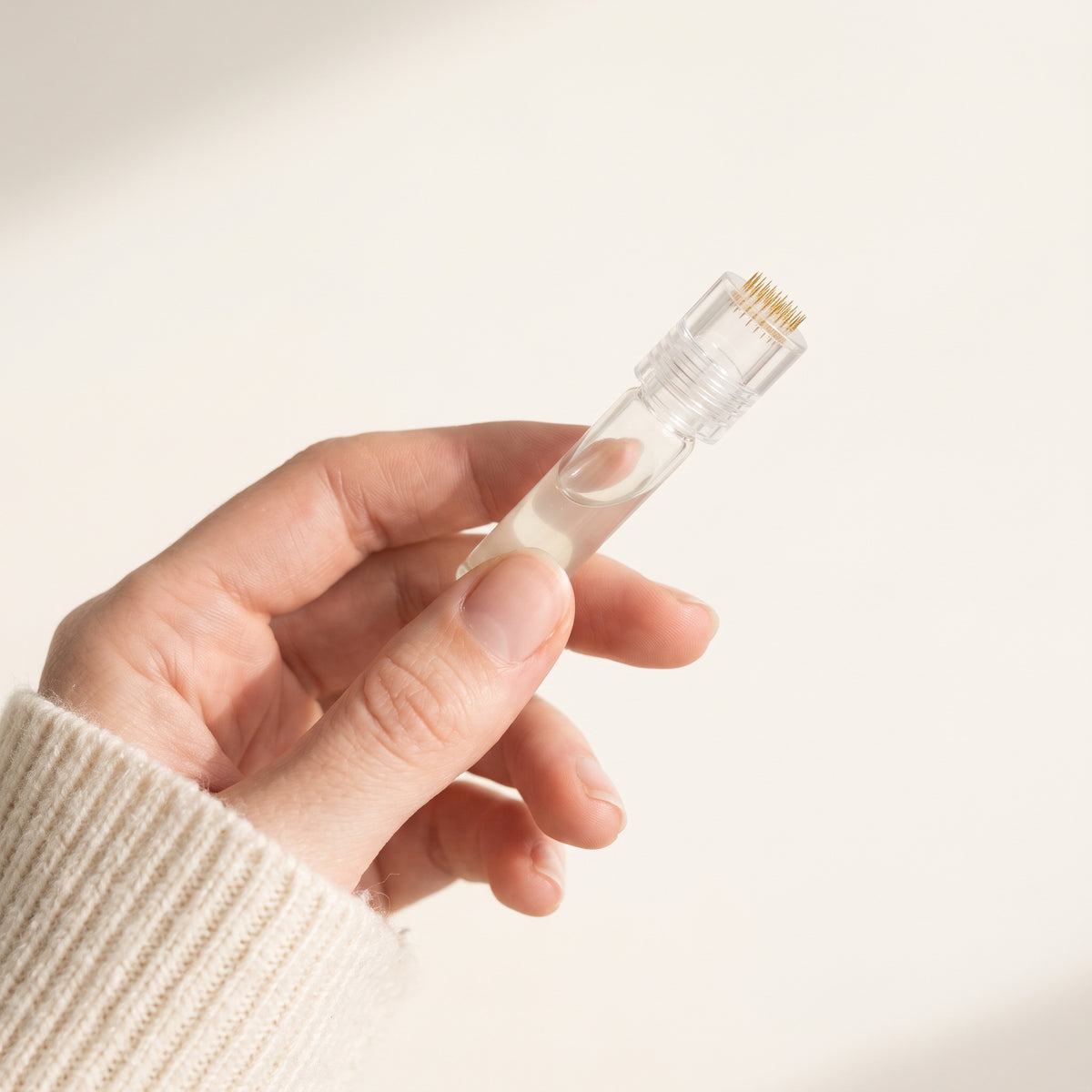
The FDA describes three shapes of device: a stamp, a roller and a pen. Radiofrequency microneedling adds a fourth.
- Stamp0.5 mm
- Roller0.25 to 0.5 mm
- Pen0.5 to 2.5 mm
- Radiofrequency (RF)0.5 to 3.5 mm
Depths come from: Jeong 2024 (stamp); Lee 2014 and Liang 2022 (roller); Merati 2020 and Alqam 2022 (pen); Yogya 2022 (radiofrequency)
Stamp
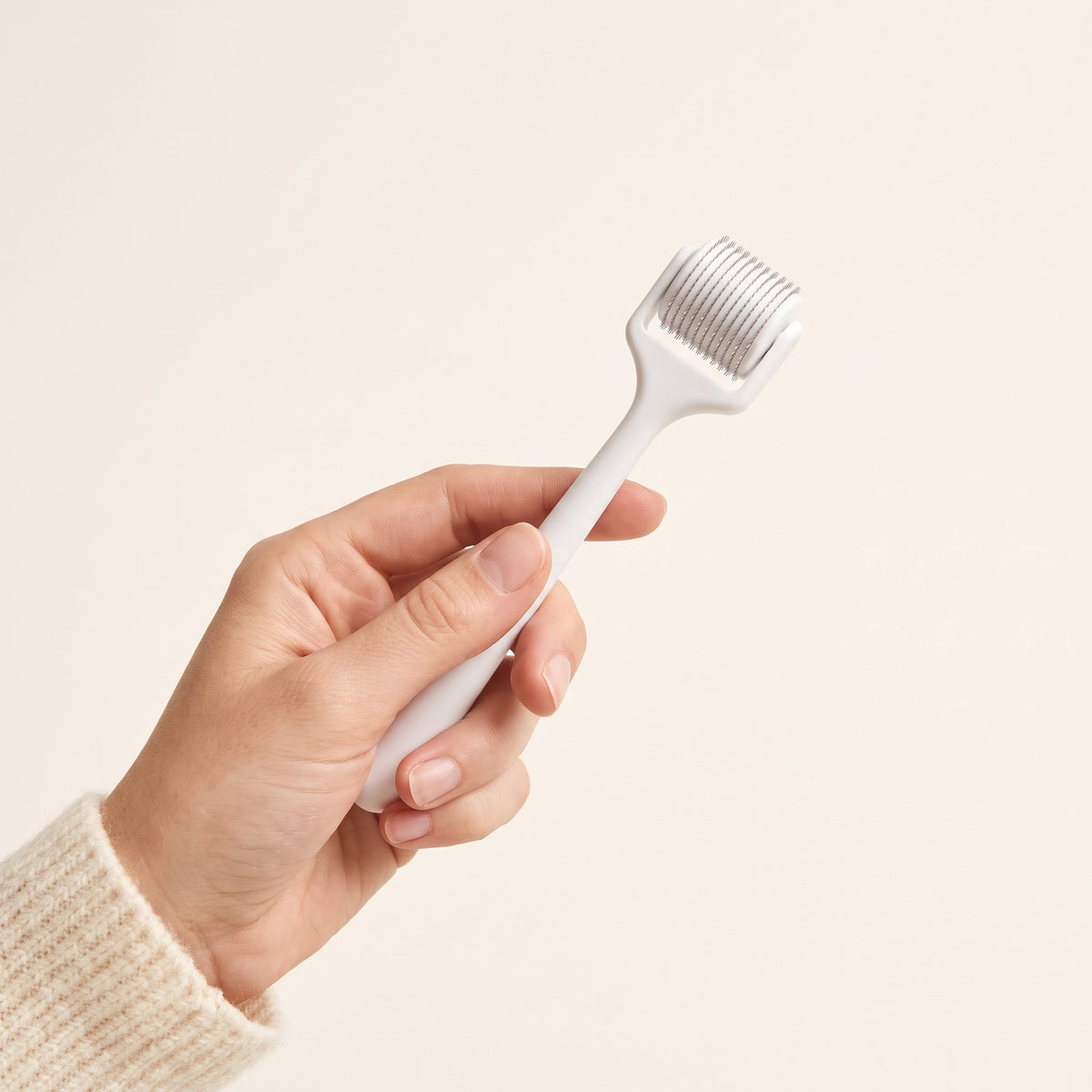
Roller
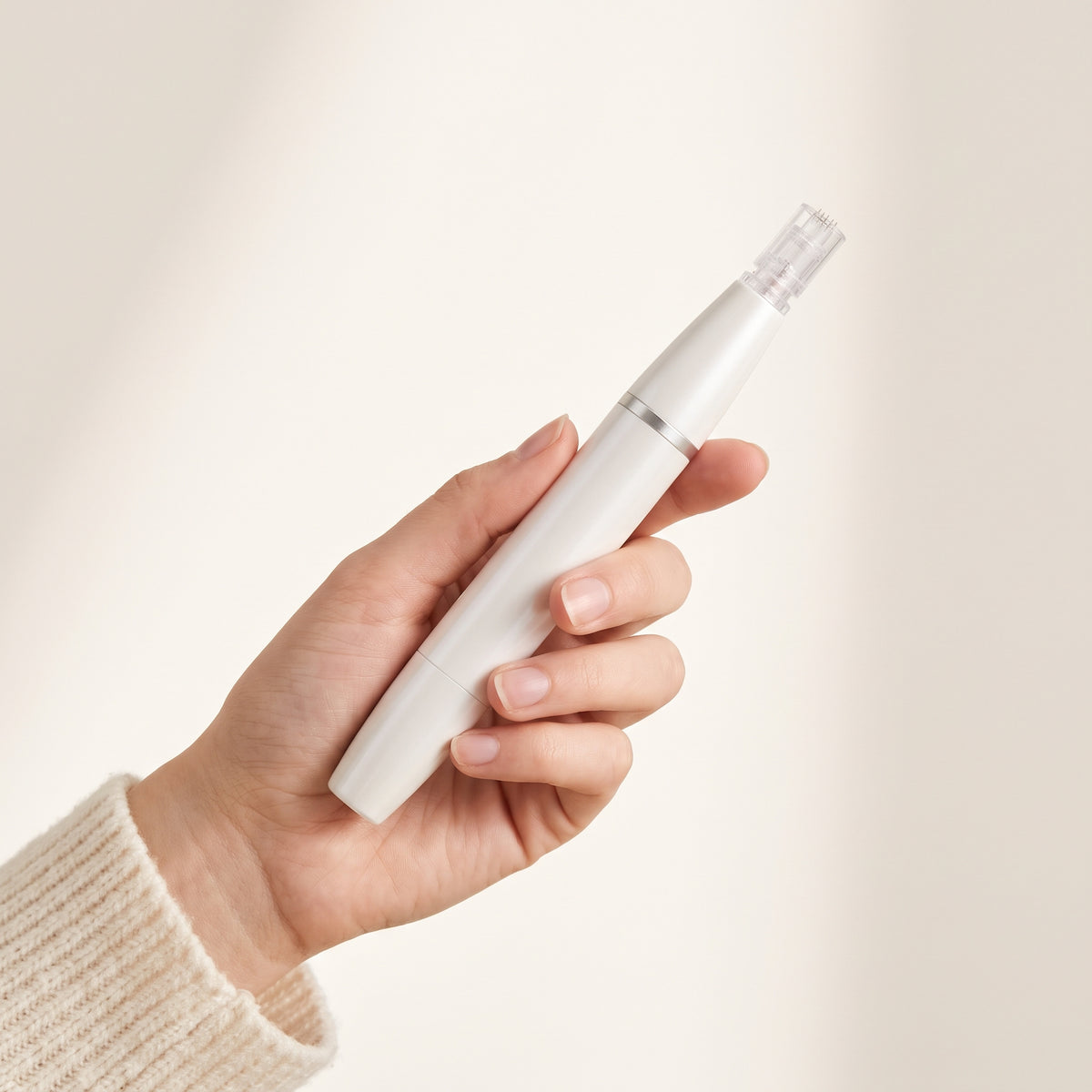
Pen
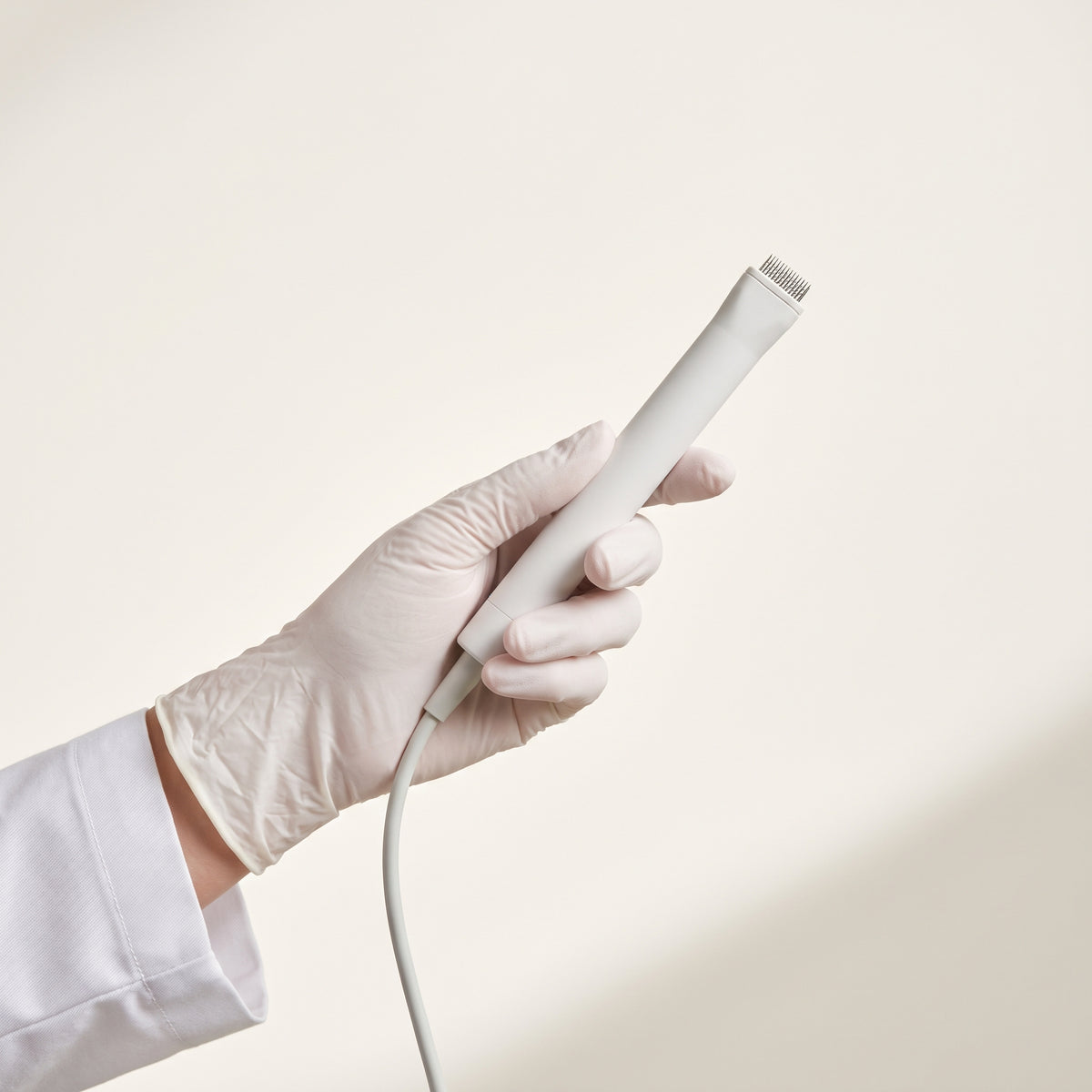
Radiofrequency (RF)
| Type | How the needles enter | Depth in the studies we cite | Where it is done | Those studies, and their limits |
|---|---|---|---|---|
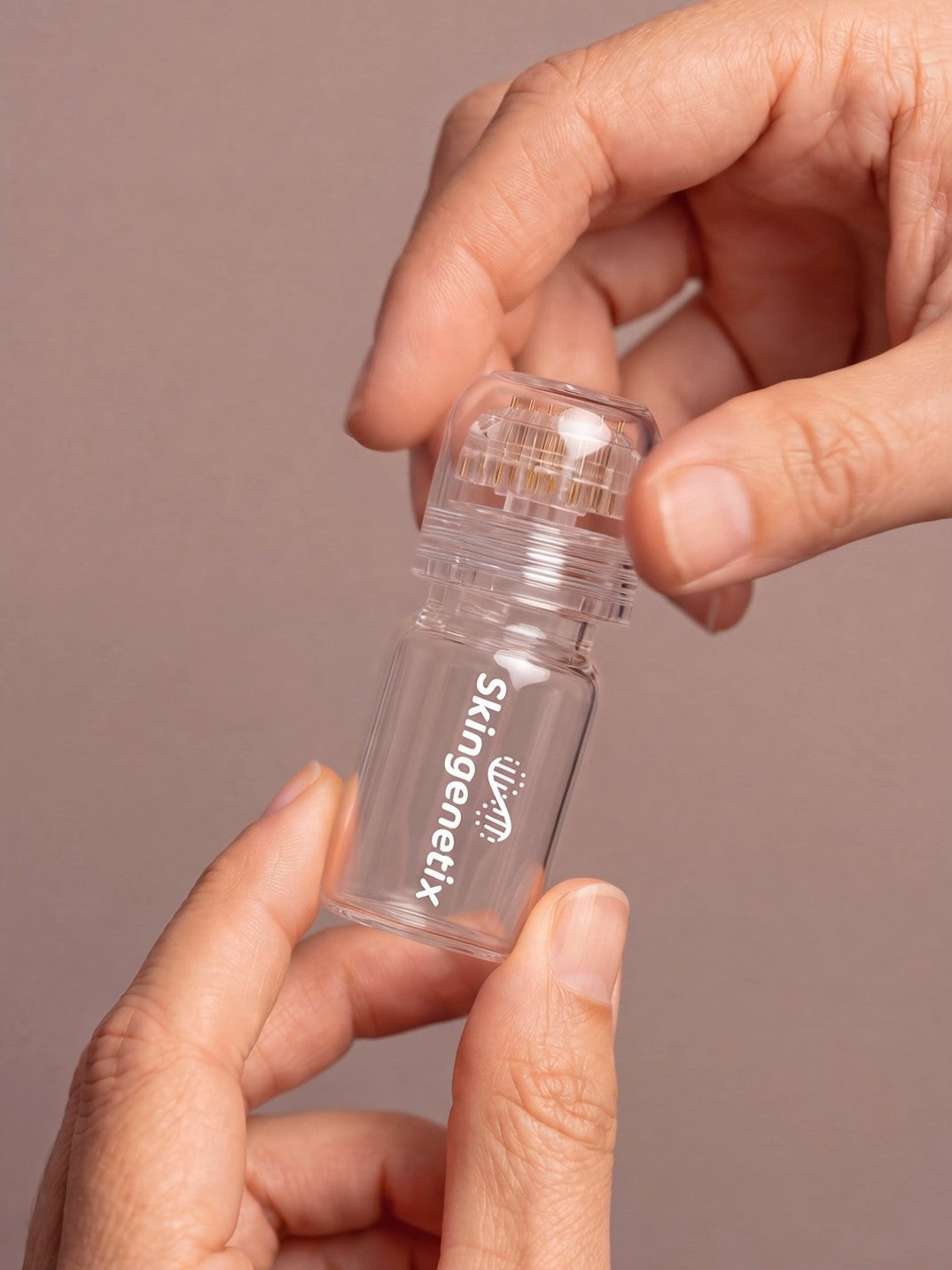
| Stamp | A flat head of needles is stamped into the skin | 0.5 mm, 42 needles; discomfort about 2 out of 10 on average (Jeong 2024) | Home or clinic | Jeong 2024: blinded, 15 adults, stamp against a placebo stamp. Limit: measured discomfort, not skin results. |
| Roller | A drum of needles is rolled across the skin | 0.25 mm (Lee 2014); 0.5 mm (Liang 2022) | Clinic or home | Both are in the table above. |
| Pen | Needles on a pen-shaped tip, which can be motorised, are pressed to the skin | 0.5 mm (Merati 2020); up to 2.5 mm (Alqam 2022) | Mostly clinics in these studies | Merati 2020: 20 women aged 35 to 60, randomised. Limit: small, four sessions a month apart. |
| Radiofrequency (RF) | Needles that also pass radiofrequency energy into the skin | Adjustable from 0.5 to 3.5 mm; 0.8 to 1.5 mm used for eye-area wrinkles (Yogya 2022) | Clinic, by a trained practitioner | Yogya 2022 is in the table above. |
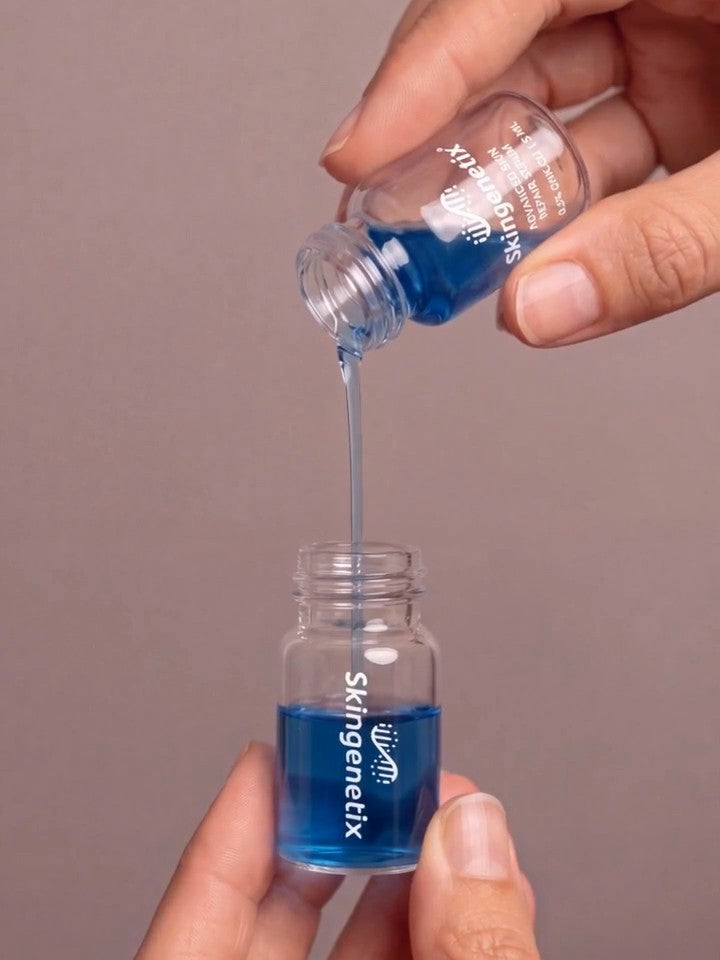
What does microneedling involve in practice?
Our guide to microneedling at home covers the steps.
What each stamp set comes with
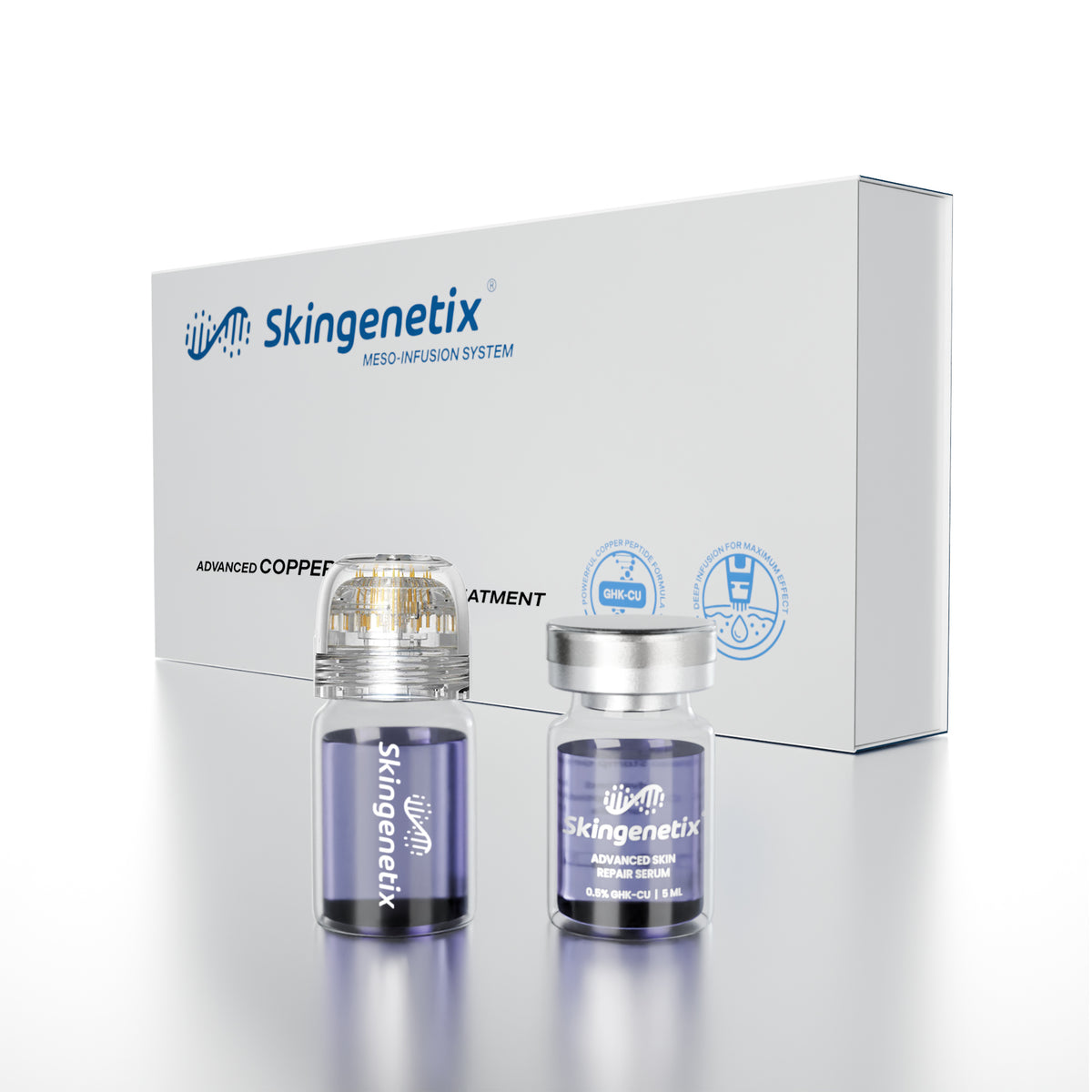
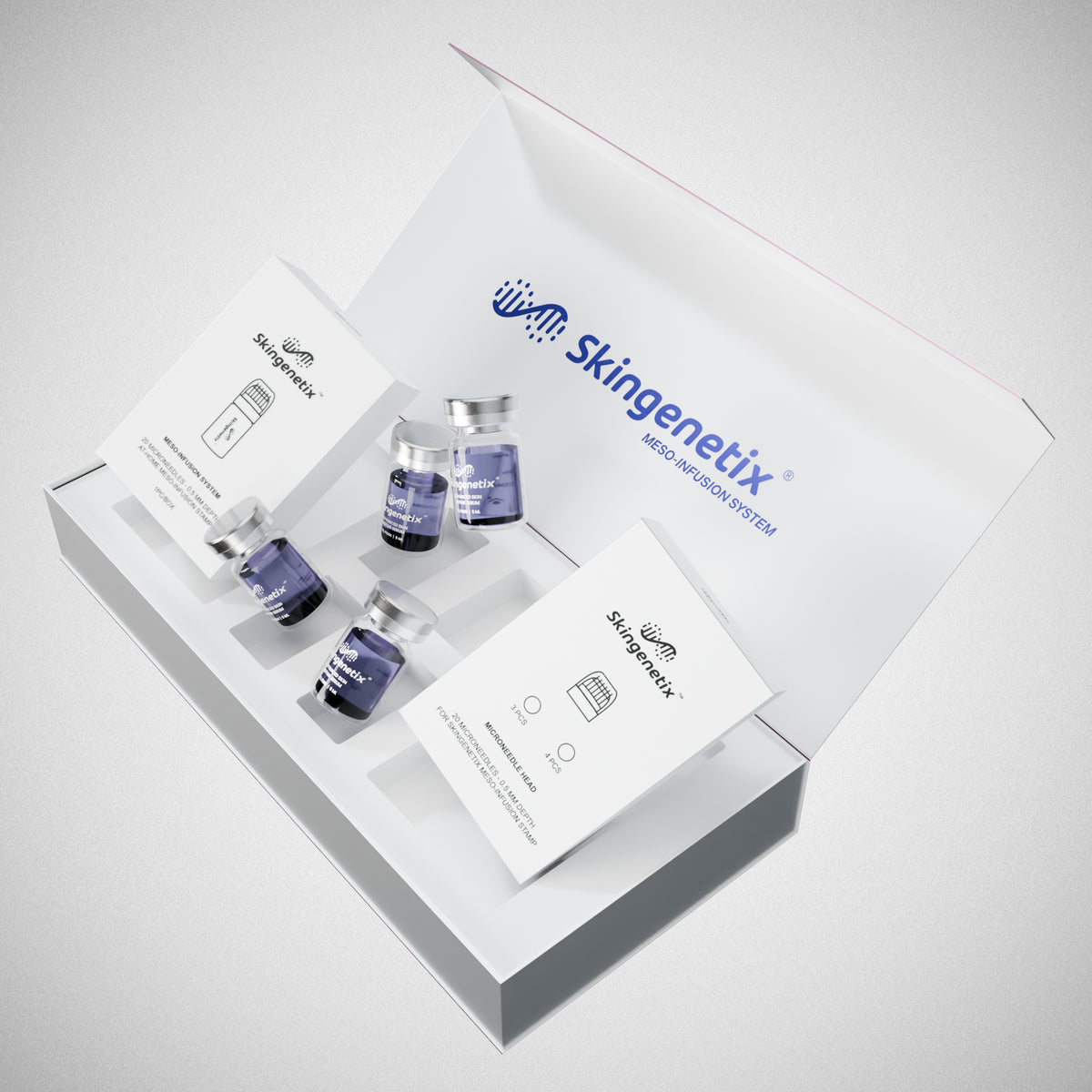
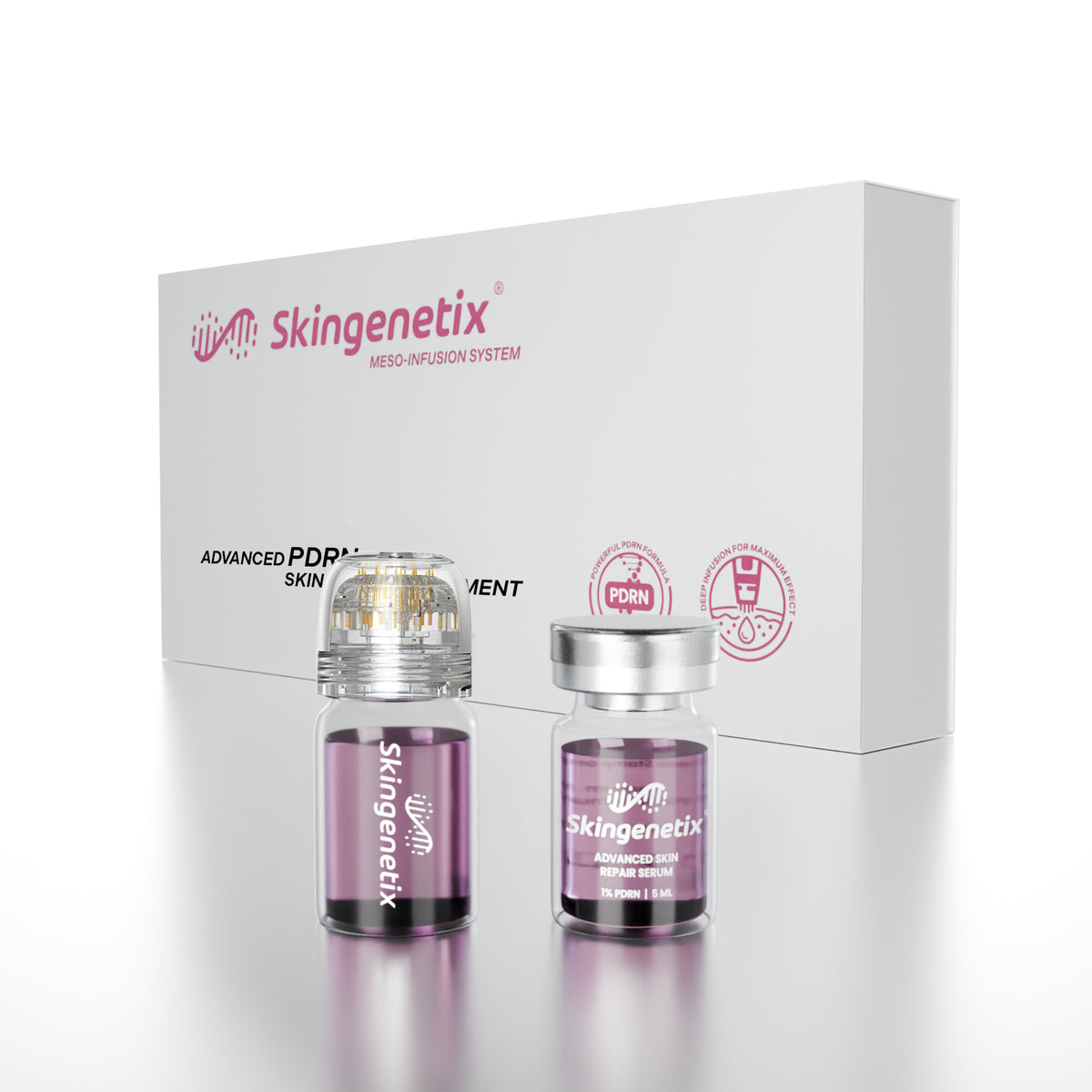
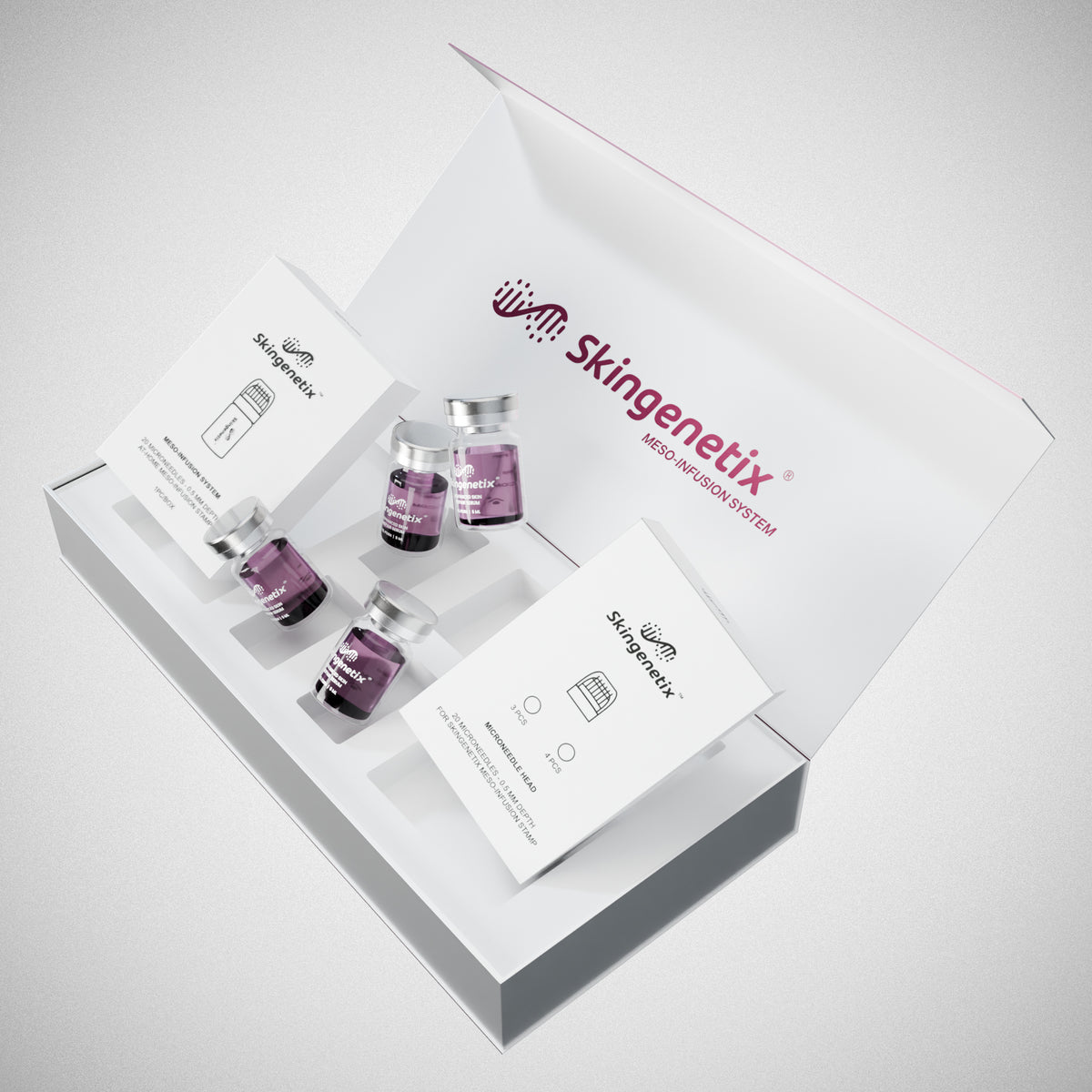
Our microneedling stamp sets each come with a reusable applicator, single-use sterile 0.5 mm needle heads and their own single-use serum vials; the directions are on each product page.
Designed for safe at-home use
The sets are designed for safe at-home use on the face, with single-use, sterile heads and clear directions. In the trials, side effects were mostly brief redness across 21 studies (Foppiani 2025), and a 0.5 mm, 42-needle stamp scored about 2 out of 10 for discomfort on average in 15 adults (Jeong 2024).
The directions, and why every two weeks
Every two weeks
- Session
- 48 to 72 hoursskin barrier
- two weeks apart
- Session
Liang 2022; Tao 2017
The directions say to avoid the eye area, the lips and broken or irritated skin, and to use the stamp every two weeks, after any redness has gone.
Why two weeks: the 0.5 mm roller trial spaced its sessions two weeks apart (Liang 2022), and at 0.5 mm the skin barrier took 48 to 72 hours to recover (Tao 2017), so it has long settled by the next session. At a shallower 0.2 mm, a home-use study ran sessions twice a week for three months with no serious adverse effects (Quinlan 2022).
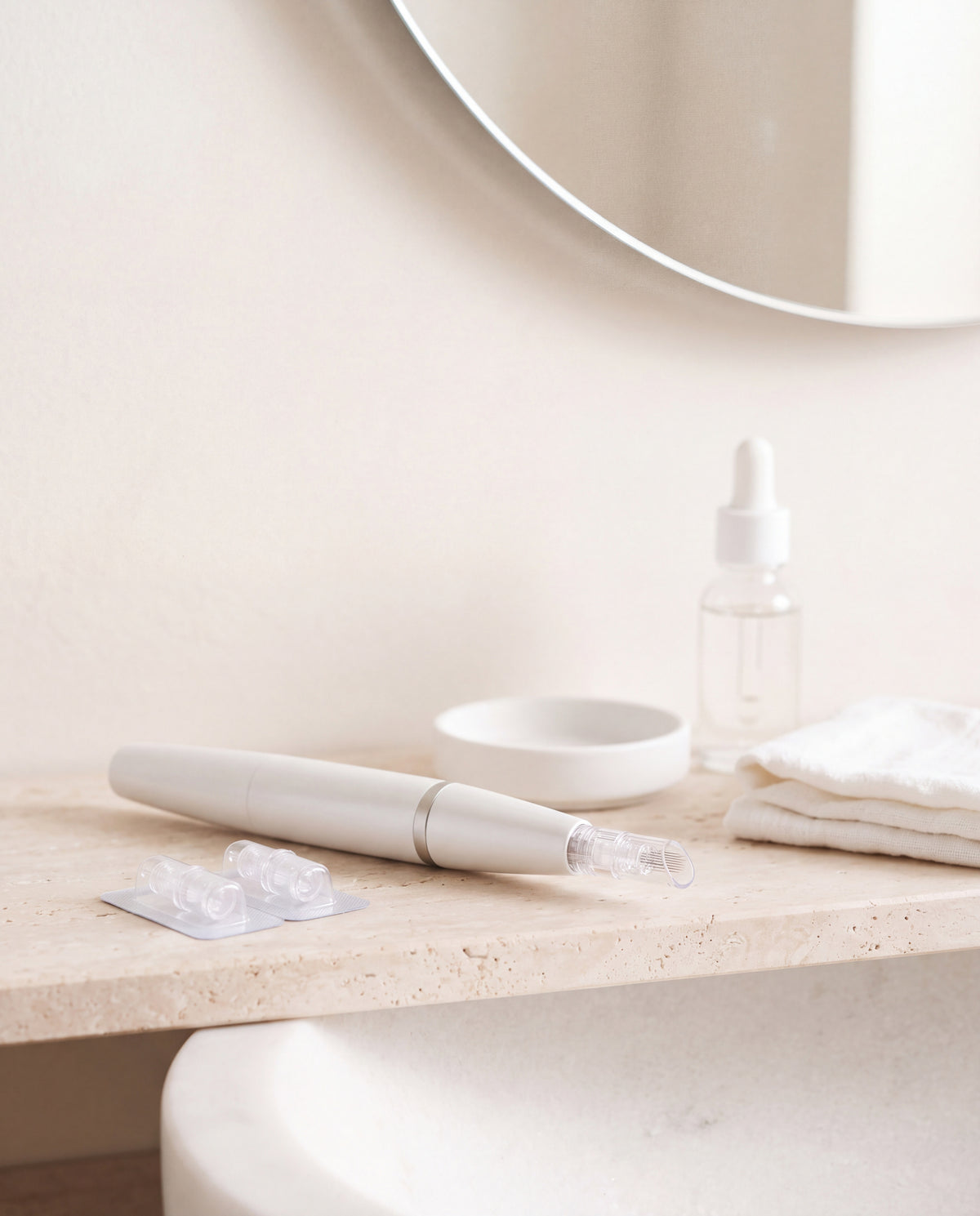
Aftercare, day by day
Our guide to microneedling aftercare, day by day, sets out the timeline for the redness, tightness, itching and peeling the FDA lists as common effects, and when to bring back retinol, acids, vitamin C and make-up.
Cost: clinic against home
Our comparison of microneedling cost, clinic against home, counts the same number of sessions on both sides and says plainly that a home stamp is not the same treatment as clinic needling at 1 to 2 mm.
The Skingenetix microneedling pen
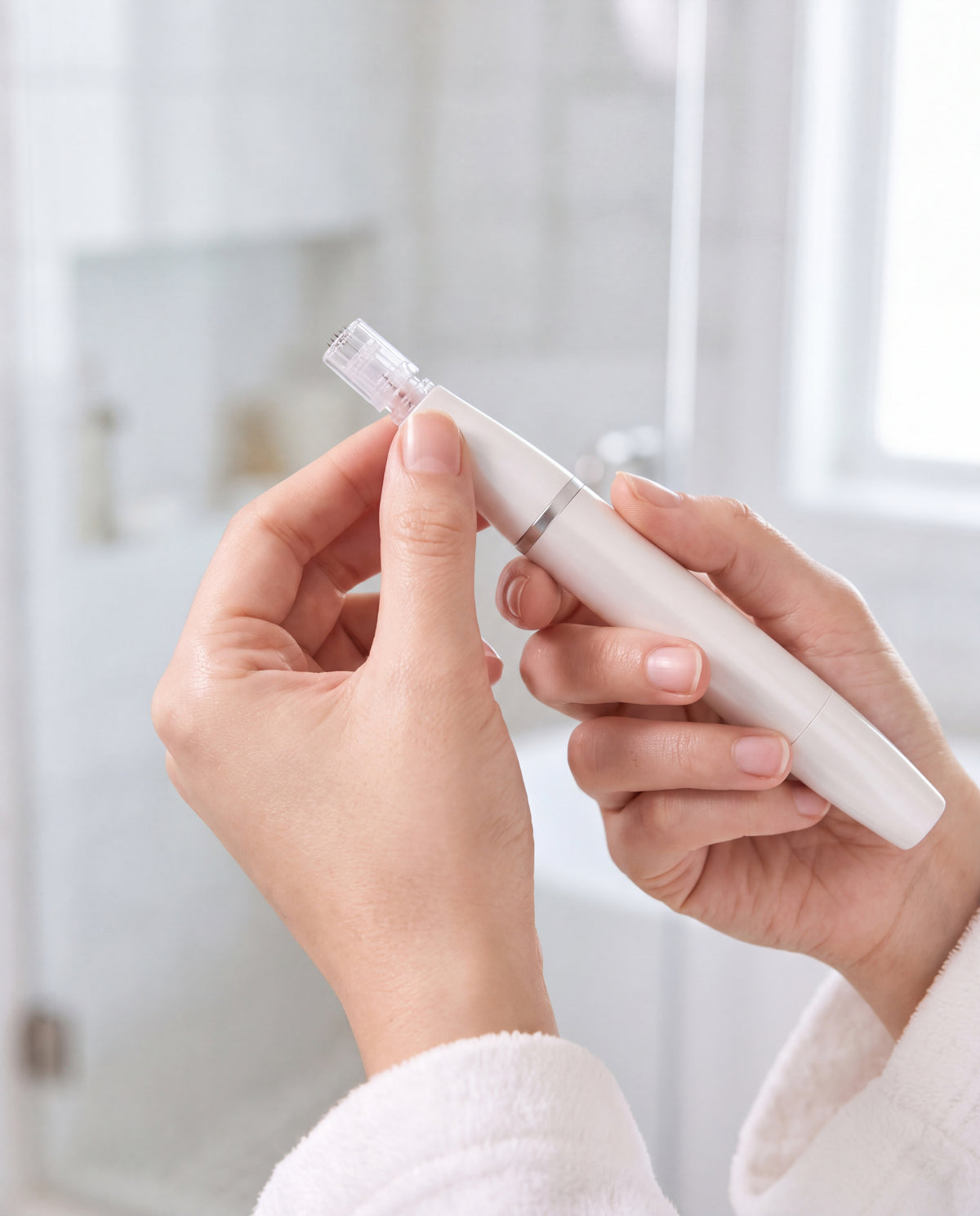
The Skingenetix microneedling pen joins our two stamp sets. Pens usually offer longer, adjustable needles than a 0.5 mm stamp, and our guide to using a microneedling pen at home explains how they differ and how to use one.

Who should not try microneedling, and when should you see a doctor?
Reviews call microneedling relatively safe (Chu 2021: a systematic review of 85 articles on side effects, one database, to August 2019), and most side effects are brief. In the 21-study review, the most common were redness (6.8%), scaling (1.7%), burning (1.5%) and itching (0.4%) (Foppiani 2025).
Talk to a doctor first, or avoid it, if any of these apply:
- Active infection, a cold sore, shingles or an undiagnosed rash. A home roller used over a shingles rash spread the virus across a woman’s face (Leatham 2018, a case report).
- A clotting or bleeding disorder, blood thinners, eczema, diabetes or a weakened immune system. The FDA says microneedling may not suit people with these, and that people with eczema, diabetes or a weakened immune system may want to avoid it.
- Metal allergy. It is a listed risk factor, and 2 of 31 adults in a 12-week double-blind split-face trial left it with allergic contact dermatitis from the device (Liu 2026).
- Darker skin tones, or skin that marks easily. Dark marks after needling are a listed risk; ask a doctor first.
- Pregnancy or breastfeeding. This page cites no research on either, so ask your doctor first.
- Broken or irritated skin. Our directions say to avoid it.
- Oils and products not made for the purpose. A systematic review advises caution with products not approved for use under the skin, and one case report describes a destructive facial granuloma after vitamin E oil and an at-home device (Huang 2025).

See a doctor if any of these follow a session:
- Redness, swelling or pain that spreads or worsens, or pus, fever or swollen glands. These can be signs of infection.
- A lump or hard, red patch. Lasting granulomas are described in case reports (Soltani-Arabshahi 2014).
- A cold sore outbreak, which the FDA lists as a possible effect.
- Redness, peeling or other effects that last longer than a few weeks.
Serious problems appear mainly in single case reports, so no one can give a rate for them.
Microneedling questions, answered
Is microneedling really worth it?
Whether it is worth it depends on your concern and the needle depth. Most people who have had it are satisfied: 83% across 21 studies and 723 people, with side effects mostly brief redness (Foppiani 2025).
What are the different types of microneedling?
Four: stamp, roller, pen and radiofrequency. They differ in how the needles enter the skin, in needle length (0.25 to 3.5 mm in the studies we cite) and in who uses them.
What is the best age for microneedling, and is 40 too old?
The research names no best age, because no study we cite compared age groups. One trial enrolled adults aged 20 to 65 (Alam 2014), the 0.5 mm roller trial averaged 41 (Liang 2022), and the 2025 review averaged 48 (Foppiani 2025). On that evidence, 40 sits in the middle of the range studied.
Which is better, microneedling or wrinkle injections?
Wrinkle injections are given by a doctor and act on the muscles under the skin; microneedling acts on the skin itself and does not stop the movement behind expression lines. No study here compares the two, so none can say which is better.
How long does it take to see results from microneedling?
Skin was assessed from 2 weeks to 6 months after the last session in the trials. The acne scar difference was significant at 6 months but not at 3 months (P = 0.052; Alam 2014), and a review of 42 randomised or blinded radiofrequency studies describes remodelling as slow and progressive, still improving 6 months after treatment (Tan 2021: clinic devices with deeper needles). No study gives a single timeline.
What happens if you stop microneedling?
No trial we cite followed people long after stopping; the longest follow-up in the table is six months. The authors of the 10-patient collagen study note that multiple sessions are usually needed to maintain the improvement (El-Domyati 2015).
Appraised by the Skingenetix Research Team. Medically reviewed by Dr Esther Bodde, Cosmetic & Medical Physician.
Last reviewed 17 November 2026.